


My mother’s grandfather was a biologist. A biologist who was intensely interested in nature, and then in particular in mushrooms. He knew everything about them, even wrote a book about them: Kinderen der Duisternis. A title that as a little girl intrigued me boundlessly, but the book has already lain unread in my bookcase for years, trapped in a cover of worn cloth and surrounded by the smell of old age.
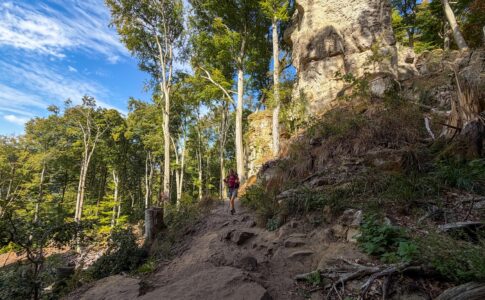
Last week we were in the Morvan, a nature park in France, where our friends Alexandra and Mathijs have a little self-sufficient farm. They are scientists who, after running a lab in Singapore for years, in the end turned their back on science and withdrew to a hamlet with eight farms. Time seems to stand still there. Noise you do not hear there, except from the farmer two farms further on who once a day comes past with his tractor. As soon as he has gone past, you are alone again with the buzzing of a hornet, the fluttering of a stonechat and the rustling of the leaves of the immense birch in the garden.
“Come,” my girlfriend Alexandra said to us the day before yesterday. “We’re going to pick mushrooms in the woods, then we’ll make an omelette with them this evening.” Yes! Kinderen der Duisternis!, the child’s heart in me cheered. Alexandra runs her farm as a true scientist, and that is how she approaches mushroom-picking too. Which is also necessary, because more poisonous than mushrooms can be, there is little. In France you can even go to the pharmacy with your picked mushrooms to have it checked whether you have not accidentally got a poisonous specimen in your basket. “Every pharmacist has had a special training for it. Saves a lot of healthcare costs!” my girlfriend laughed.
“We’re looking for ceps, tepelparasol mushrooms and meadow mushrooms,” she said when we set off. I was already immediately impressed: a tepelparasol mushroom! The name alone. “But for the meadow mushroom I think we are already too late in the season.”
“What should I look out for, Alex?”
“The tepelparasol mushroom stands high on its stem and has a white with light-brown cap. But if there is no nipple on it, it is not the right one. And around its stem is a little ring that, when it is ripe, can be pulled loosely up and down.” We kept our eyes tightly directed at the forest floor and tried to find the mushrooms among the thousands of fallen leaves that formed a blanket of red, yellow, green and purple under our feet. “And a cep is a thick mushroom with a large cap, which is especially to be recognised by the tubes standing close together under the cap, which look like a sponge. Just look!” She picked up her pocket knife, cut through the stem of an impressive specimen and showed me the underside. “Look, and if you press into that sponge, it becomes blue. Do you see?” She pressed on it, and lo and behold, a green-blue colour came out.
At the end of the walk there lay ten children of the darkness in our basket. An omelette has never tasted so good to me.
I wrote this column as an assignment for my course Columns & Blogs at the Schrijversacademie.
This post was translated from Dutch with the help of AI. Read the original Dutch version.


No comments