

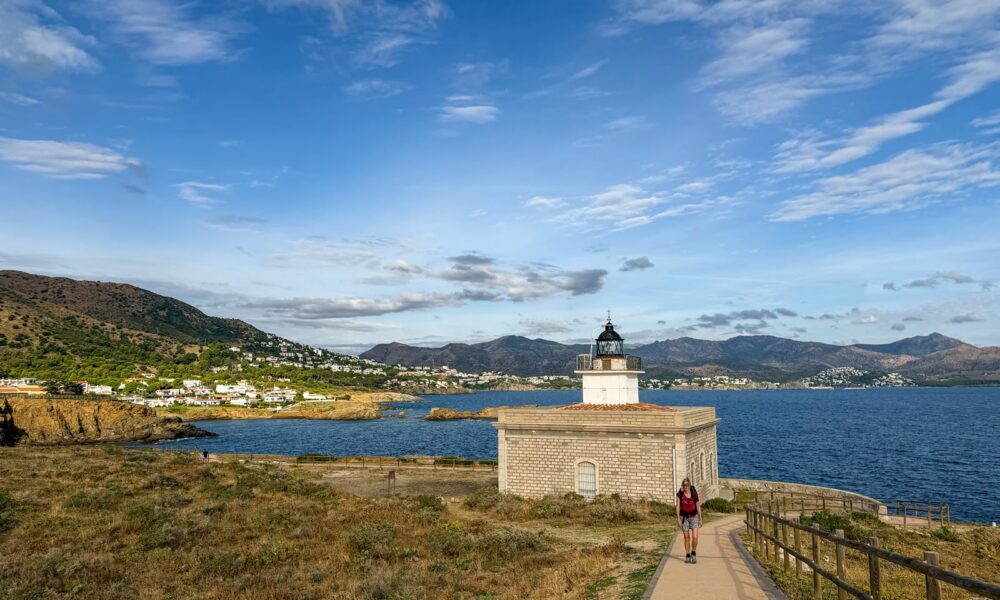
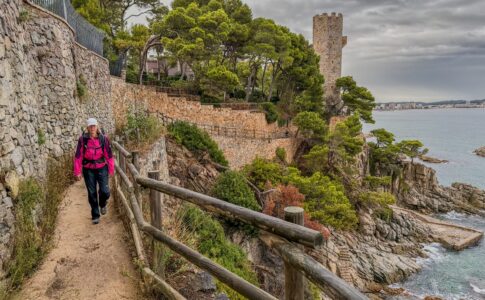
While the first fishing boat heads out of the harbour of Llança and a lone man casts his rod from a rocky spot, Piet and I walk in the morning sun along a path between the sea and the inhabited world. What goes on behind the houses is a mystery to us; all we see is how sunlight reflects on the calm little waves. All we hear is the soft sound of the sea, with the occasional modest ‘bof’ when a wave hits the rocky coastline, and the cry of a gull. A group of five older women are doing tai chi on our path. Spain is slowly waking up, and so are we.
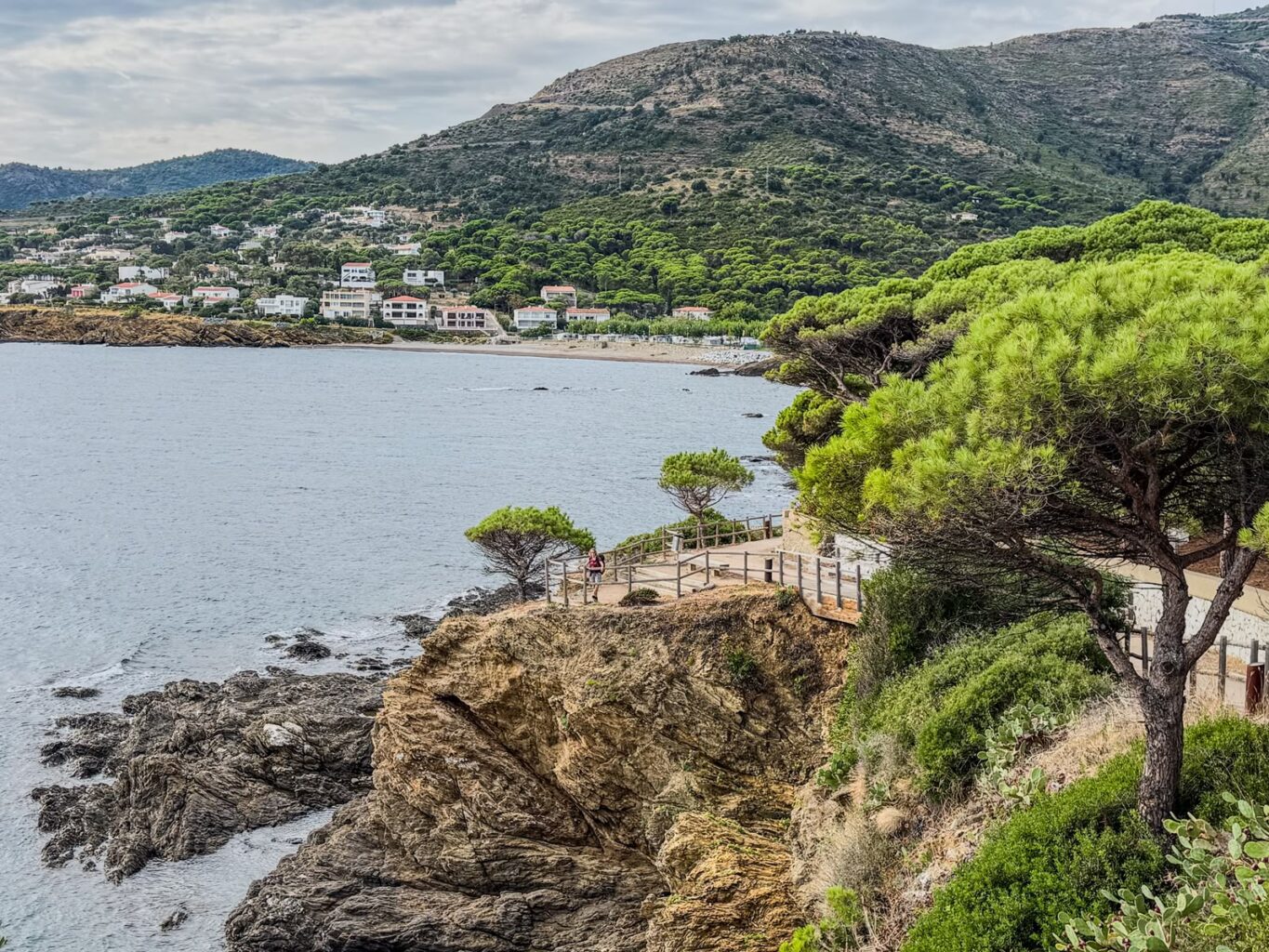
The first eight kilometres go over this constantly rising and falling, but comfortable path right along the coast
Married for sixty years
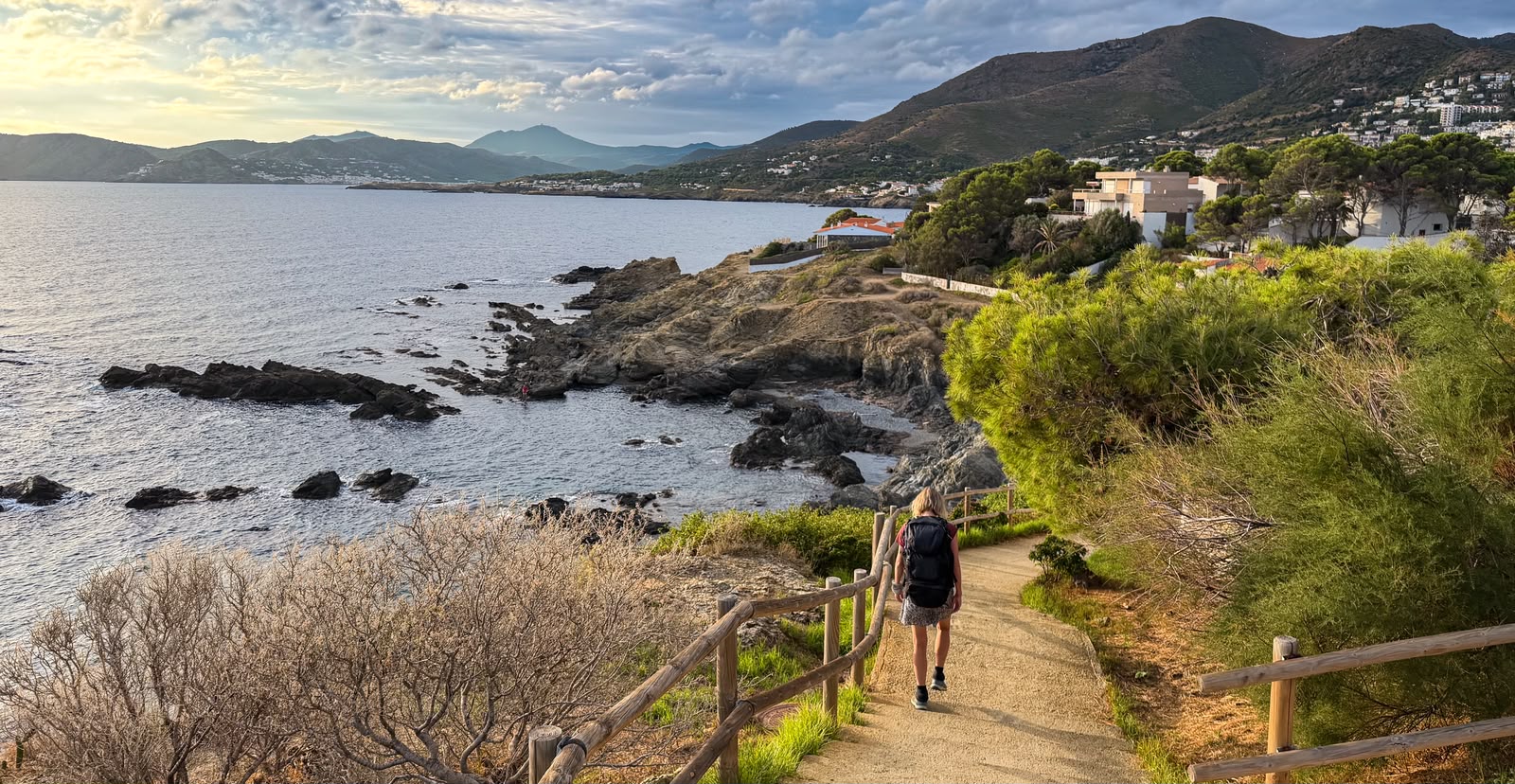
At a certain point I see Pieter standing somewhere ahead of me next to a couple. They are peering down, where rock formations lie in shallow water and the seawater is a deep blue. ‘Look,’ Pieter points when I come closer, ‘there are cormorants hunting.’ Three black cormorants shoot through the water like penguins. They dive under, we can barely follow them as they dart through the shallow water looking for little fish, and then they come up again. We get talking with the couple. Belgians from Wallonia, who are here on holiday. What the prompt is, I don’t really know, but at a certain point they confide in us that they have already been married for sixty years. I look at them with wide eyes. Married for sixty years? But you yourselves are barely sixty! They turn out to be 81 years old. Clearly proud of their age and of each other. So sweet. ‘Would be great if we managed that too, wouldn’t it?’ says Pieter as he takes my hand while we walk on along the path. I quickly work out how old we would have to be then. Pieter 107, me 102. Should be doable 💪🏻
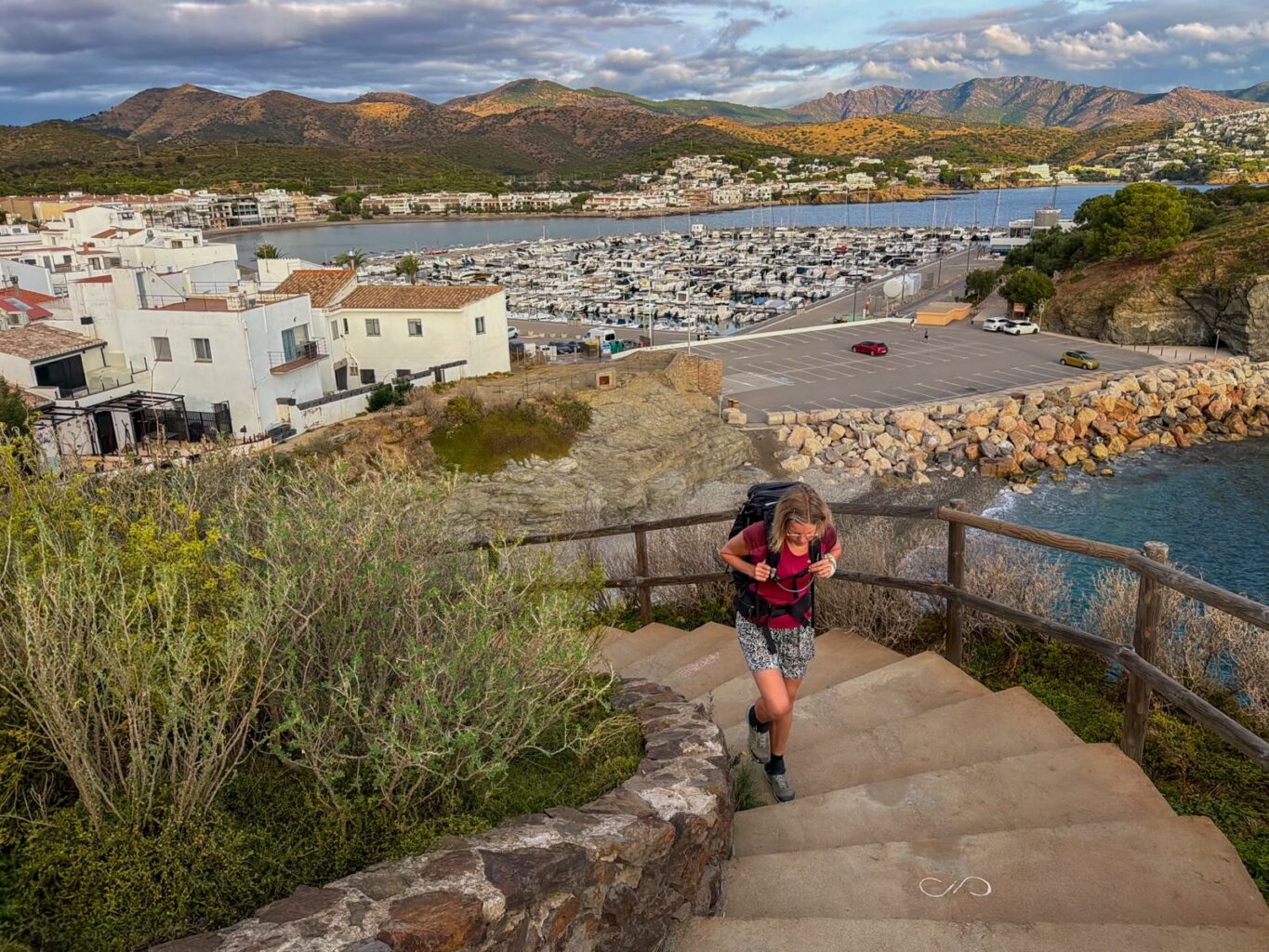
Llança behind me. You can even see our little golden car standing on the right in the car park. It will stay here for 12 days.
Throwing a stick
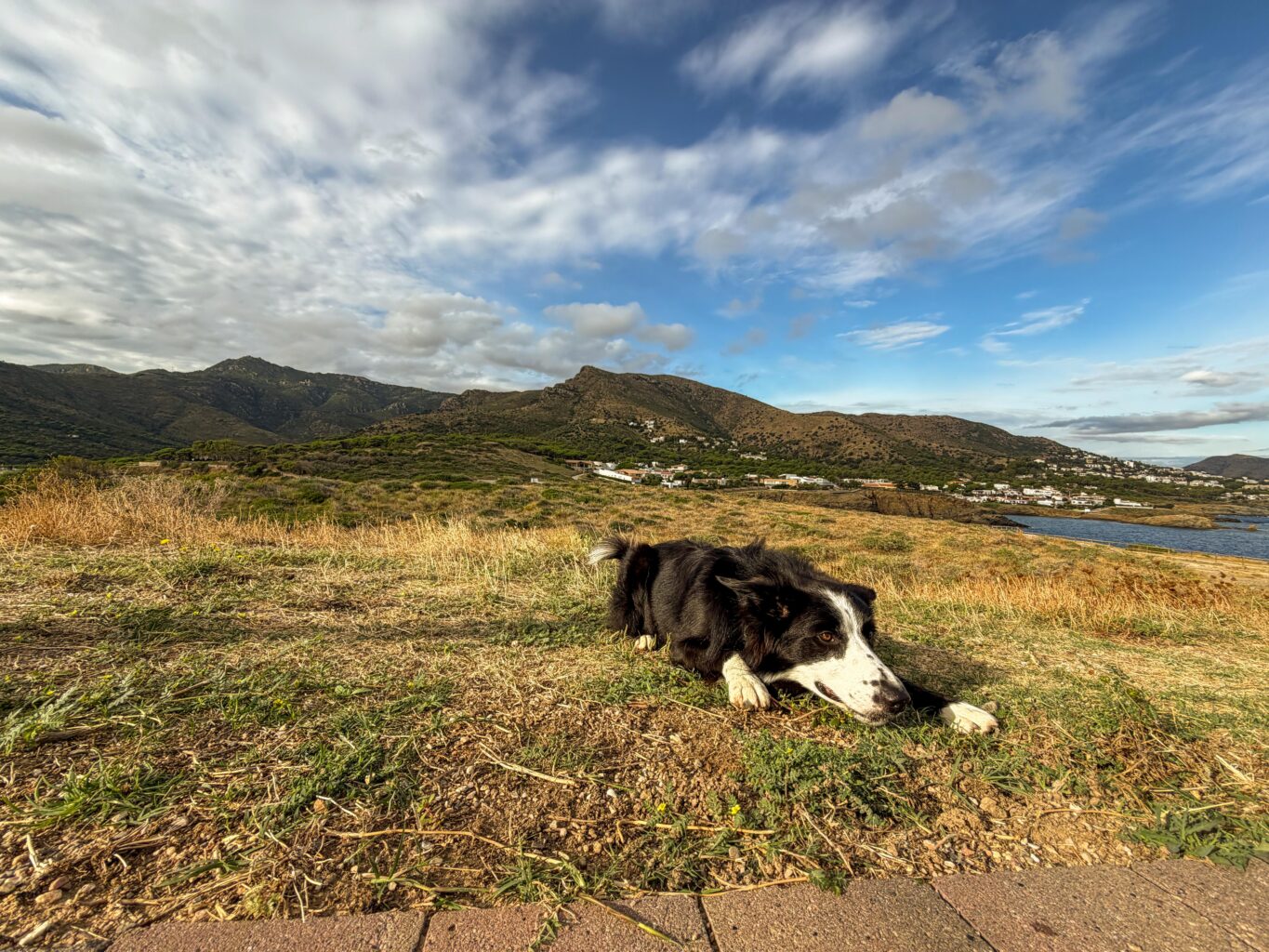
When we are close to the Faro de s’Arenella, the northernmost lighthouse along the Catalan coast, a black border collie comes running towards us. He drops a little stick right at our feet and lies down. His gaze is completely fixed on the stick. Right, clearly, we will throw it for a bit. Barely three minutes later I have thrown the stick twenty times (poor dog, that stick weighs nothing, so it keeps fluttering down about a metre and a half away from us) and I have had enough. His owner, a young girl, comes along. ‘Does he ever stop?’ I ask her. ‘Never. He can go on with this forever, he simply does not get tired.’
‘And you?’ I ask, laughing. She rolls her eyes. ‘I do.’ She strokes the animal’s head. Then she says something unintelligible, at which the dog promptly drops the stick and walks with her. It looks so companionable. Pieter and I have had long conversations time and again about getting a dog, and we have come to the conclusion that such a creature does not really fit our way of life, but at moments like this…
Danes on the GR92
A few kilometres further on, just as we are about to walk into El Port de la Selva, we catch up with two people with large rucksacks. A short conversation tells us that they are the Danes Leif and Nina, who are also walking the GR92, like us as far as Tossa del Mar. They tell us they were here 45 years ago Interrailing. That’s right: Interrailing. We did that then! When we meet them again later, panting from a tough climb, Nina tells us they have just walked past the hotel where they stayed then. They barely recognised it. Where it was then a charming little hotel, it is now a huge box without a soul. They also visited Jávea, near where our house in Spain is, in 1980. I am sure they would not recognise that any more either if they took another look. That is how it goes, of course, when a place is very beautiful: a lot of people simply flock to it.
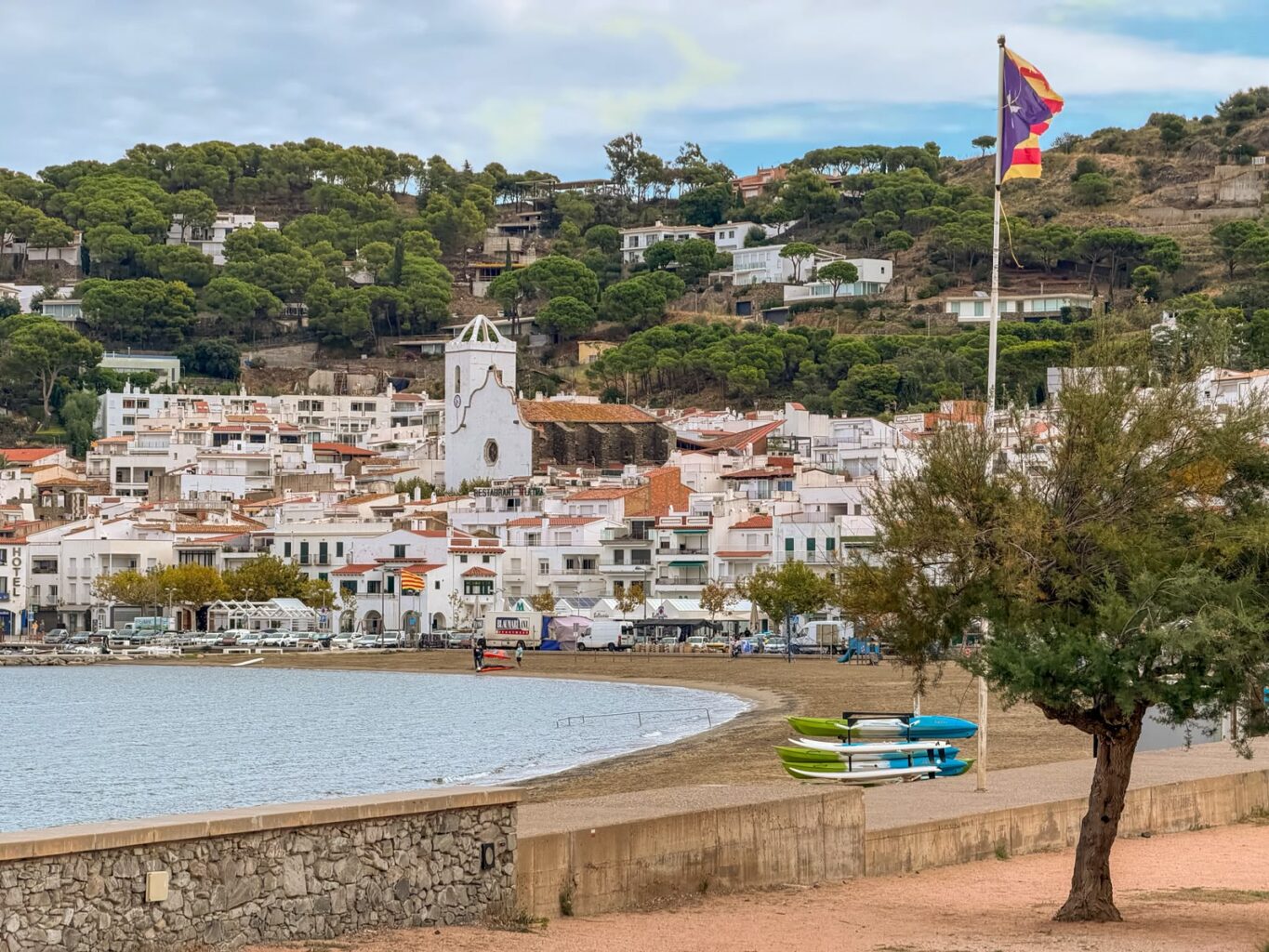
El Port de la Selva

In conversation with Leif and Nina, after we have ended up high above El Port de la Selva once again
Cap de Creus
Even so, the GR92 does not yet seem to have been discovered by the crowds. All on our own we walk through the nature reserve of Cap de Creus. The edges of the stony path are again full of prickly pears, whose aubergine-red fruit stands out beautifully against the grey of the path and the intense green of the disc-shaped pads. There is no village to be seen any more, only traces of wild boar and shrubs such as tree heath and goldenrod among the cacti. In the distance the sapphire-blue Mediterranean glitters all the way to the horizon.
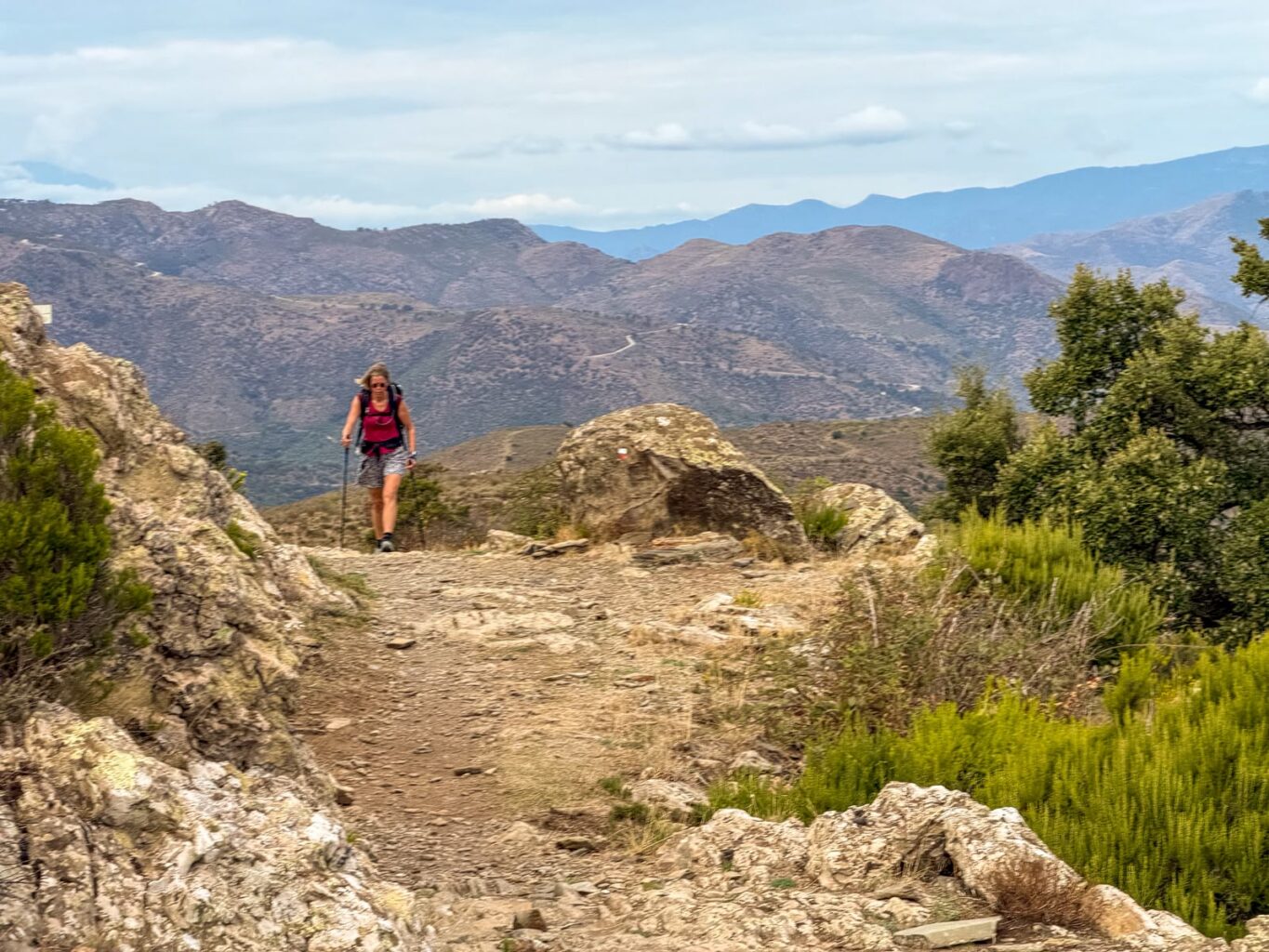

Besides Nina and Leif, the only person we meet today is Ellen from the Netherlands. About her we still know nothing, except that she finds all this climbing and descending quite hard going. We are bound to bump into her later, and then we will hopefully find out why she is walking here. At any rate she is taking it calmly and in a relaxed way; she books nothing in advance, but simply sees how far her legs will take her.
Descending to Cadaqués
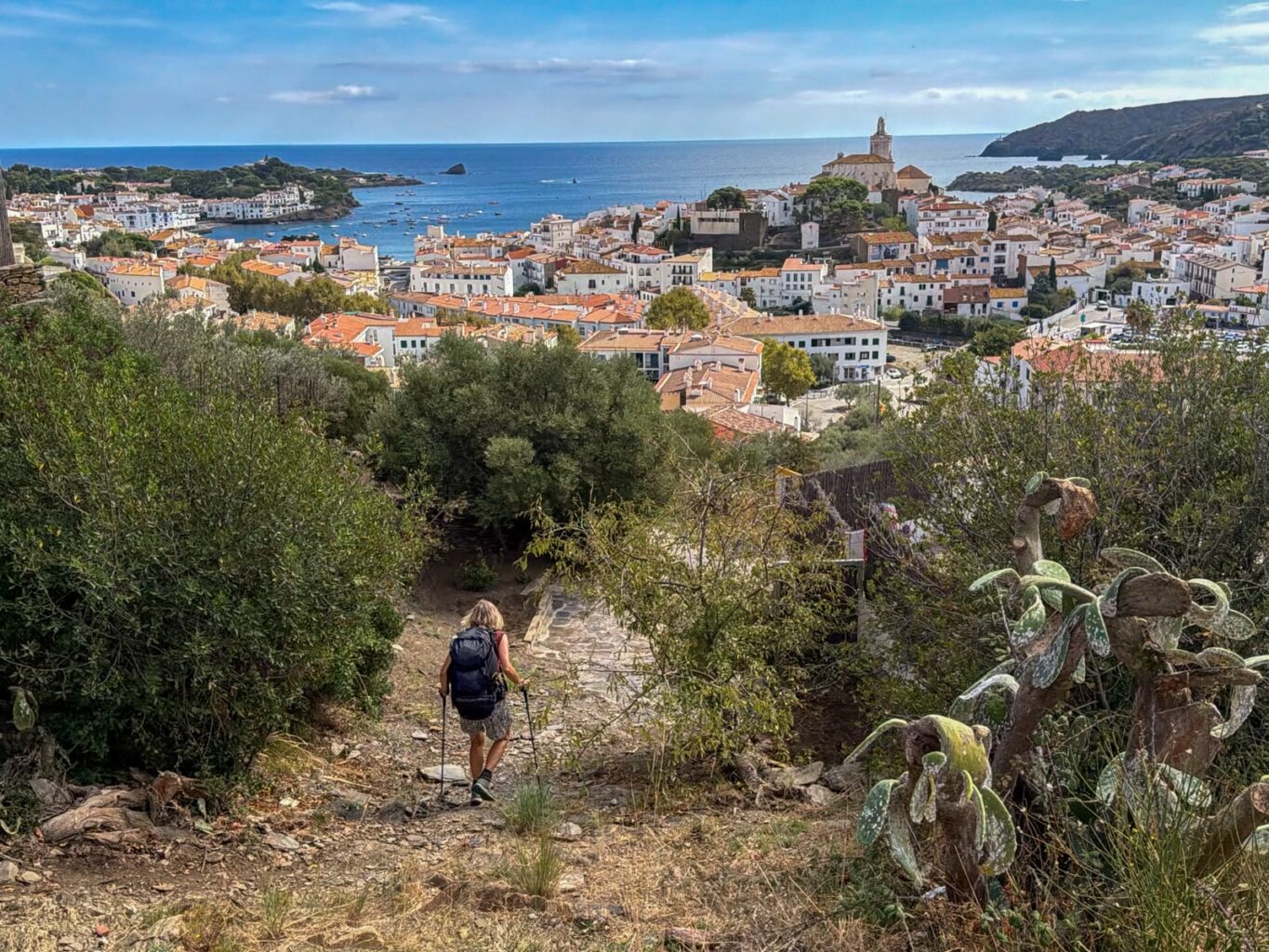
When we catch our breath for a moment at the top of the mountain after the climb, we see the lighthouse of Cap de Creus in the distance. It was built in 1853, which makes it the second-oldest lighthouse in Catalonia, and with the moon-like landscape around it it has inspired many artists, including Salvador Dalí. We will not look at the lighthouse up close; our stony, steeply descending path goes towards Cadaqués, the beautiful town around the bay of Cadaqués, where all the houses are whitewashed and the streets are narrow and winding.
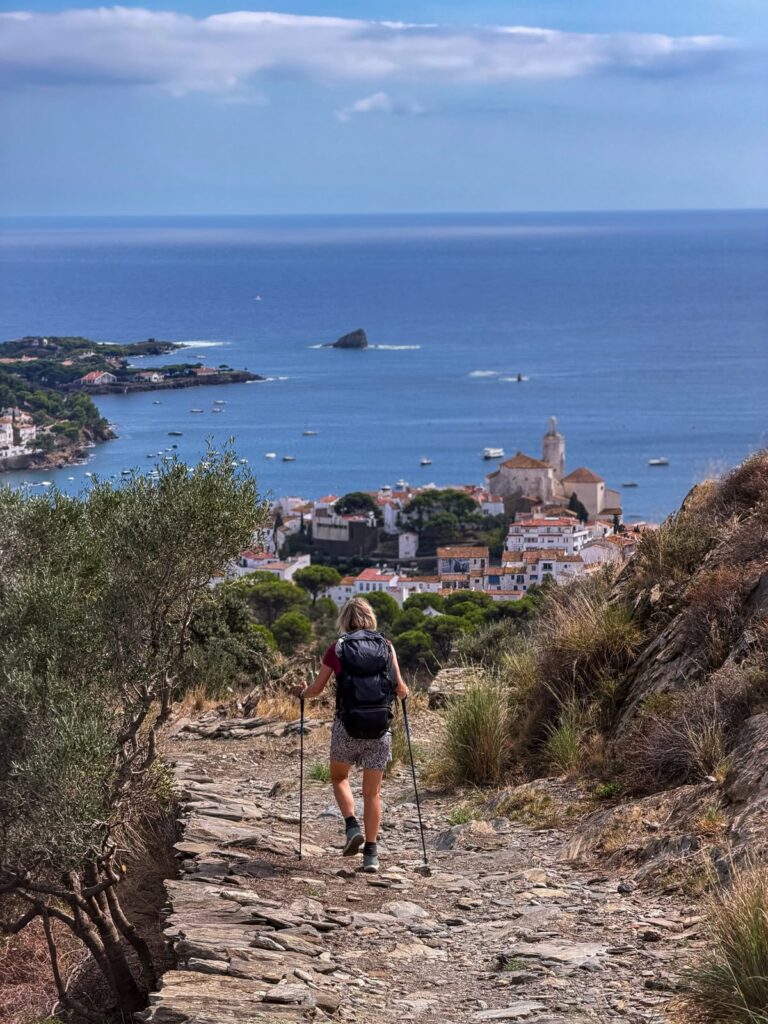
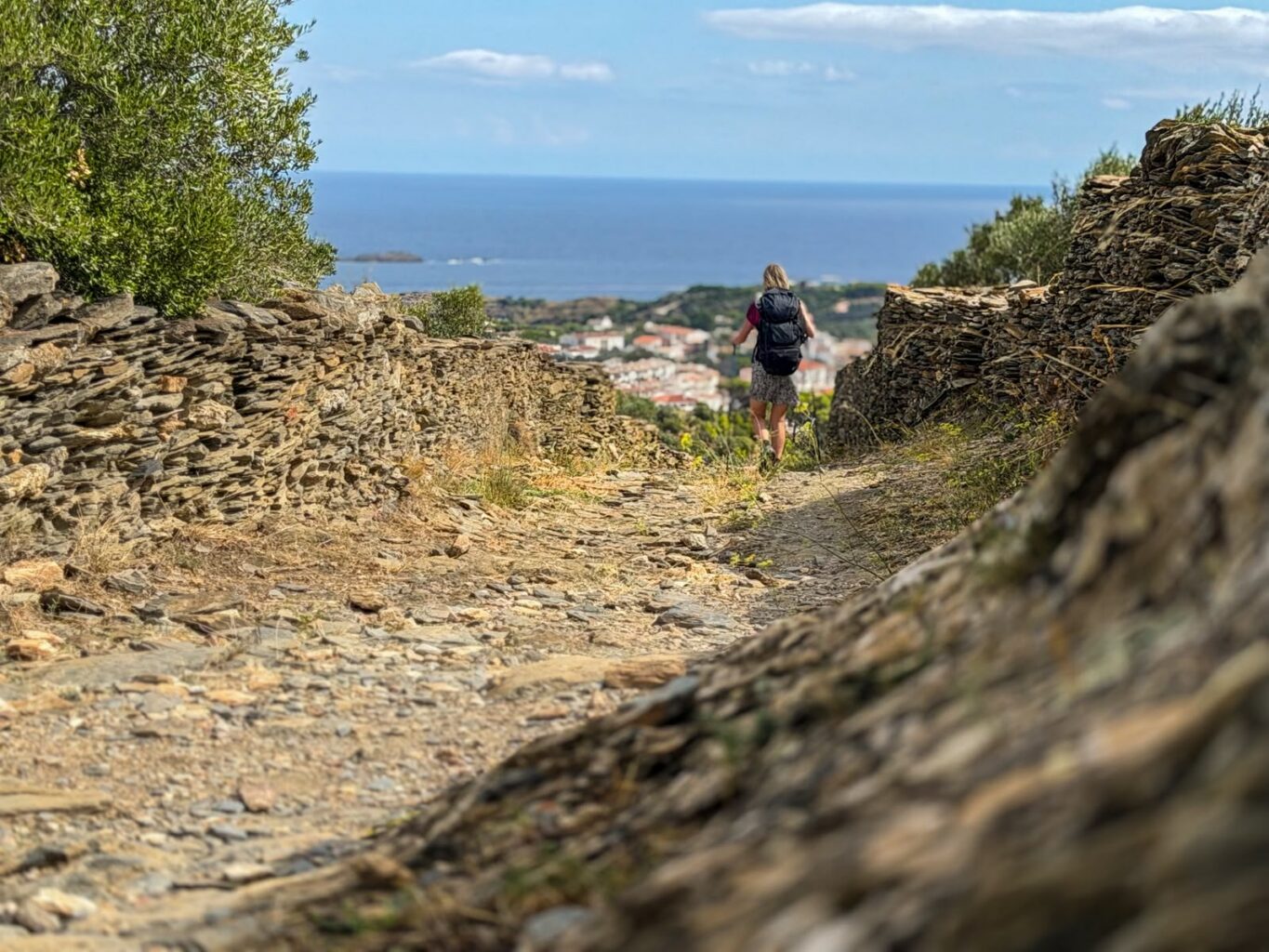 We can see it lying there from a long way off, with the Iglesia de Santa Maria in the middle of the village, high on a hill, and the fishing boats in the bay. This little artists’ town of Cadaqués is regarded as one of the highlights of the GR92. Perhaps in a little while, over a cold glass of rosé and a little anchovy the fishermen here have long been famous for, we should just see whether that is so 🤩
Staying at: Hotel Cadaqués1962, done out entirely in 1960s style
Distance: 19 km
Elevation: 489 metres up, 451 metres down
We work together with WAW Travel. For this walk, WAW Travel provided our overnight stays and breakfast. More information
This post was translated from Dutch with the help of AI. Read the original Dutch version.

No comments