

 stage 1 of 4
 You walk from Le Chazelet to Pic du Mas.
Breakfast does not equal last night’s dinner, but it comes close. We treat ourselves to delicious coffee, cake, bread with cheese and cooked ham, delightful homemade yoghurt, and all of that with a view of the glacier of La Meije and the peaks around it. After everyone has packed their bag, we drive past the épicerie for some provisions for the way and then on to the car park where we will leave our car for the duration of the hut-to-hut walk. Ecktiv’s description is not consistent about where this car park exactly is. With a bit of driving back and forth and some discussion we finally find a spot. Backpacks on our backs, poles in our hands, cap on our head and a cheerful spirit in our heart: we are on our way!
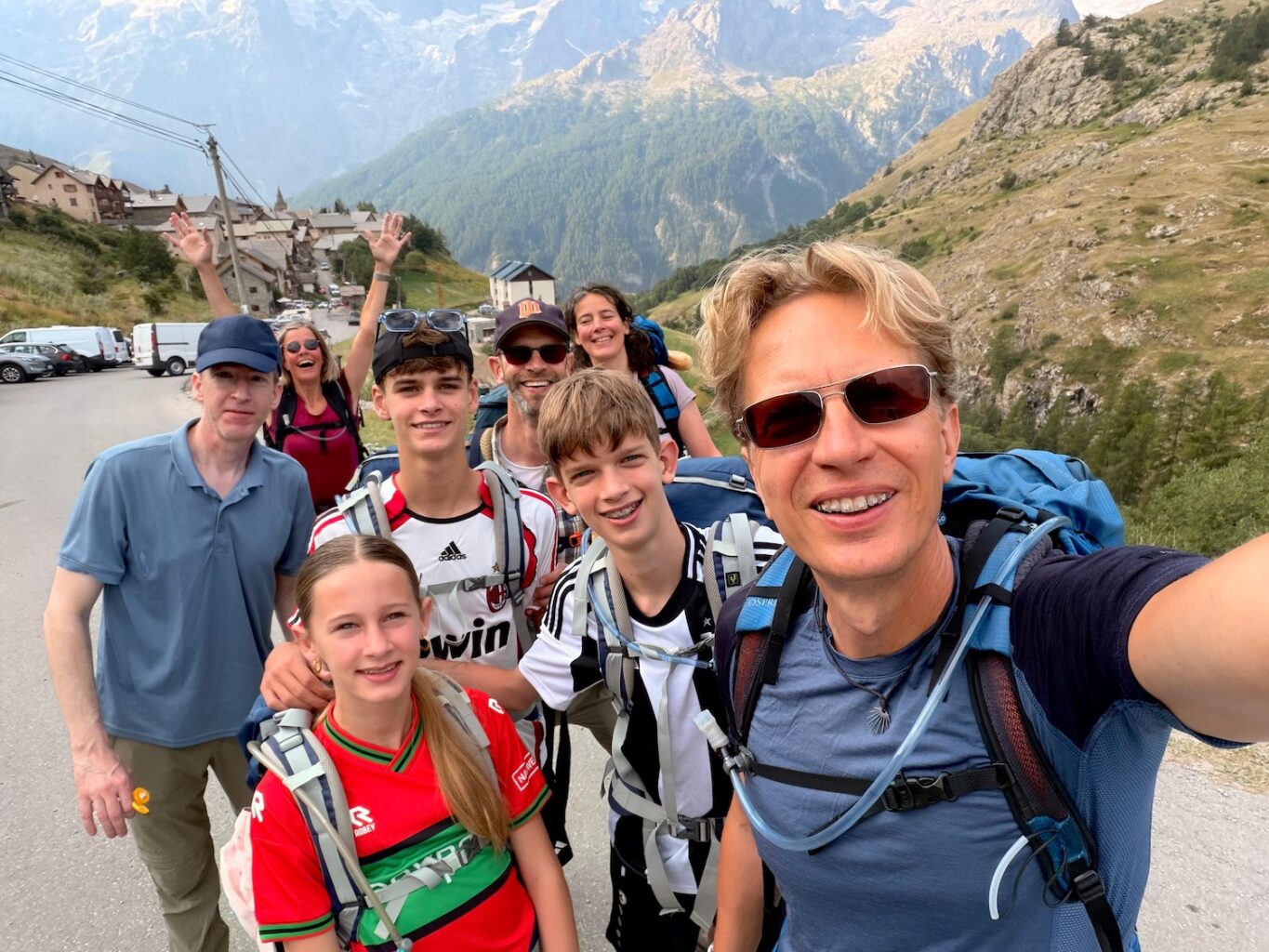
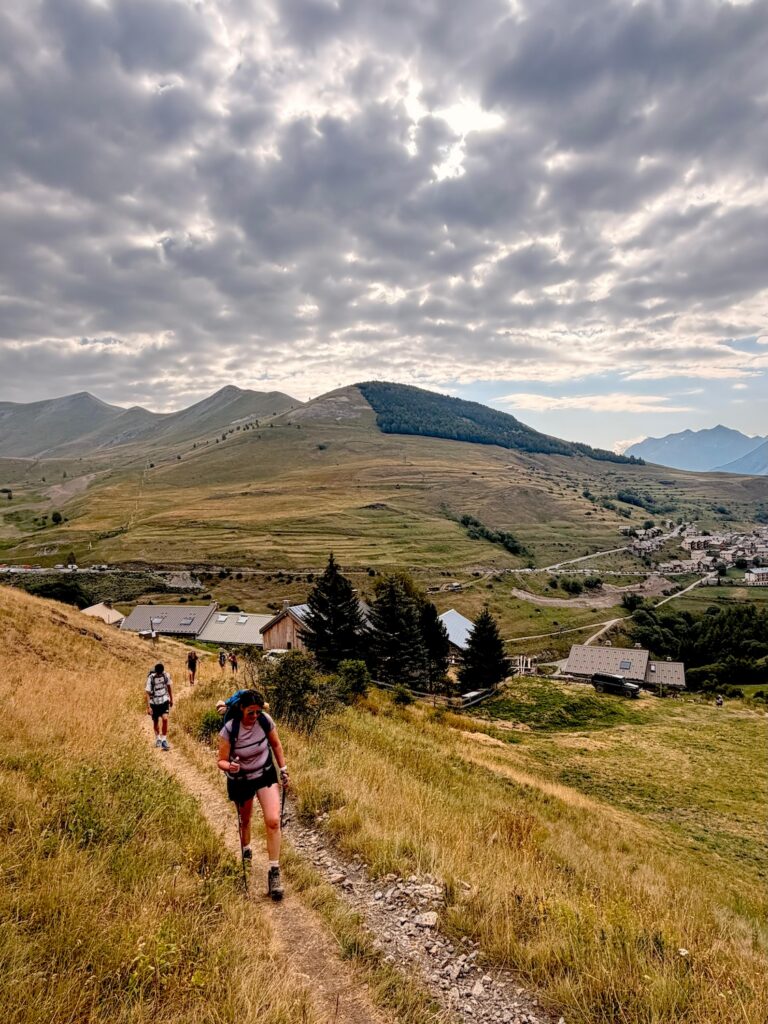
Not even five minutes after we leave Le Chazelet, we have to go up into the air. And not just a little! We try to find our rhythm, but well, we have barely started. The shoes feel strange, the backpack is heavy, do we seriously already have to walk on our toes because it is so steep?
‘Calf-biter,’ I hear Pieter mutter.
‘My backside already hurts,’ I complain.
‘Well, this has certainly woken us up straight away,’ is Lotte’s comment.
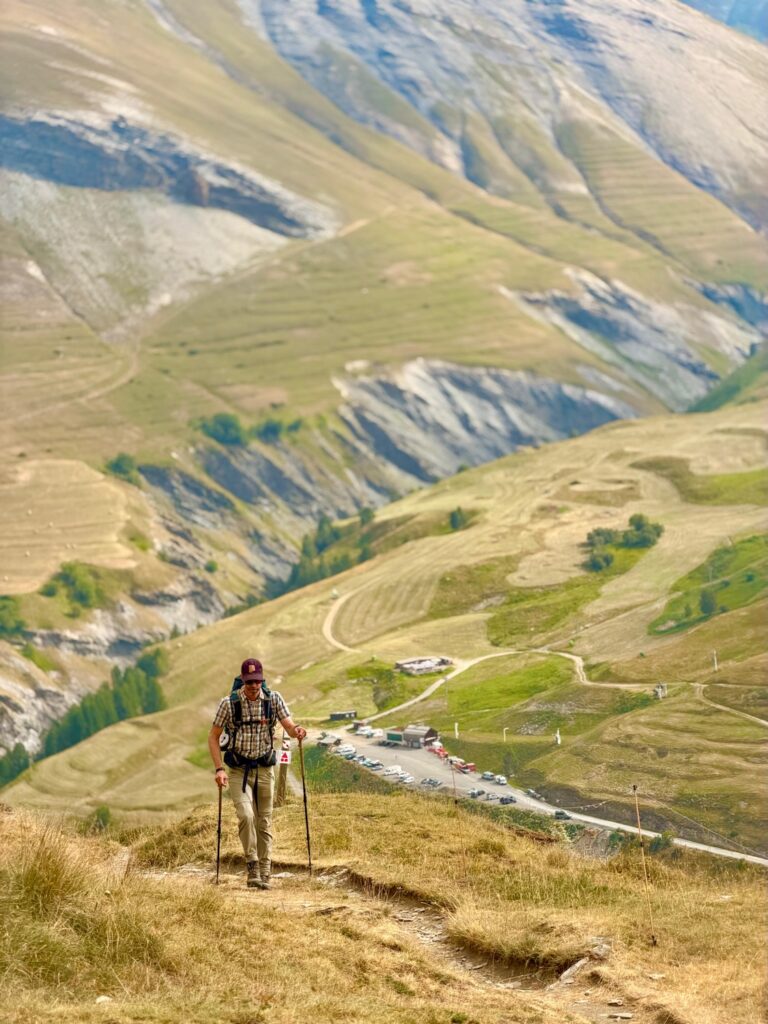
Below, our car is parked
‘War of the pastures’
Between the panting we do look up now and then. A smile on our face is simply impossible to hold back; it is so incredibly beautiful here. We stand still a lot to take in the grandeur of the mountains around us. On a gently sloping green hillside directly in front of us Katrien points out two roe deer along a tree line. The high squeaking we hear now and then betrays the presence of marmots. What we do not know is that we are walking here in an age-old conflict area. The high pastures of La Grave, Besse and Mizoën were listed as the best pastures of the Alps, essential for the survival of these mountain communities. In 1366 La Grave claimed the rights to these alpine meadows, much to the displeasure of Besse and Mizoën. After all: without pasture no livestock, without livestock no life in the mountains. Lawsuits were brought, fines were issued, sheep were put out to graze on land that according to one belonged to the one and not to the other. First Mizoën came into conflict with La Grave, later it was Besse that openly sought a quarrel. Various arrangements were made by judges but none of them lasted.
Only in 1555 did a royal decree give permission for the sale of parts of the pastures. Mizoën bought a part, but the deed of sale was lost. From that moment history writing seems to pass into legends. Of the mayor of Besse, for example, it is said that he disappeared mysteriously from the face of the earth when he was on his way with legal papers with which he could claim land for his community. Stories also circulate about hidden and moved boundary stones, invented or at least embroidered by the rival communities. Even in the 19th century, between 1816 and 1851, the conflicts flared up again. Now, however, there has been peace for quite some time and we notice nothing of everything that once played out here.
Bearded vulture
We completely lose Tom early in the morning. He seems to have joined the friends Marcel and Armand, who are clearly keeping a higher pace than we are. Herjan walks far behind the rest; he stands still at every little beetle, moth, butterfly and cricket he sees. Pieter is as ever busy with his camera and sometimes lies stretched out in the field for a particular shot, but in doing so does take the most beautiful pictures. Lotte chatters my ears off companionably, Katrien keeps an eye on whether everyone is doing all right, Gijs walks through the middle of it all chalk-white with factor 50, and Max ambles along with Herjan.
At a certain point I am walking just ahead of them and see several birds circling above me. ‘Look,’ I point, ‘there you have red kites.’
‘I don’t think those are red kites, you know,’ says Herjan, ‘their wings don’t have the right shape for that. A kite’s have a kink, these are straight and rounded.’ The three of us stare at the large birds high above us. ‘I don’t know what they are.’
We walk on and then suddenly such a bird comes right over us. It has little speed yet, I think it has only just taken off, and it beats its wings. Max and I can hear the sound of it from where we stand. Herjan is called, he comes over to us and follows the creature in the air. ‘I think that’s a bearded vulture!’ Bearded vultures eat the bone marrow of carcasses, I know, and are relatively rare. That we now meet one here, barely two hours into our walking tour, really feels like a gift. Capturing it on camera, however, proves an impossibility…
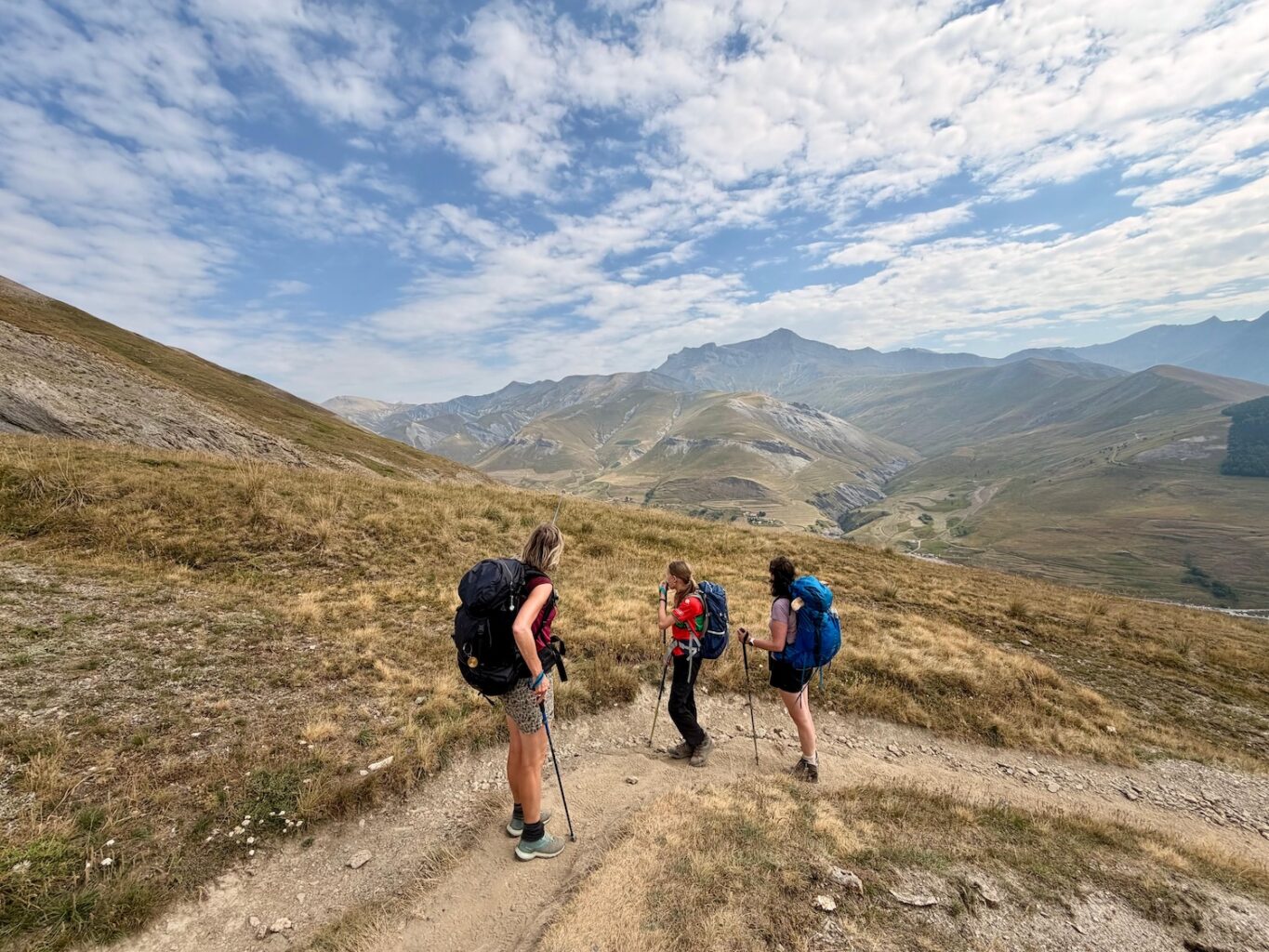
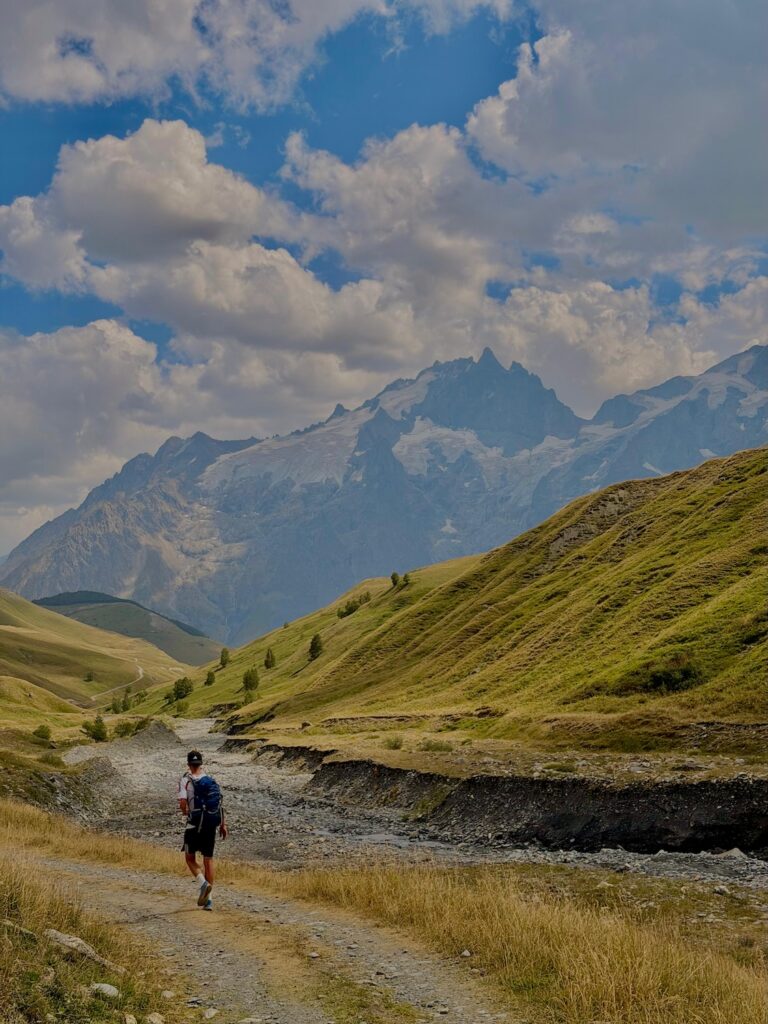
After lunch Tom is nicely walking with us again
Gone the wrong way
In the afternoon, once we are past Col du Sauchet (2,365 metres), Tom is in our midst again. Lunch has been gobbled up, sunscreen has been smeared on again, and without realising it we join a couple of other walkers. After a while we notice that that is not clever, because they walk straight to a refuge where we are not supposed to be. It looks sociable, but it does not exactly lie on our route. Ai… Fortunately Pieter sees a little shortcut, and in single file we descend fairly steeply a meadow full of hollows and holes. I have to think of the boy in the sports shop yesterday, who told us that you may not walk in this nature area without studs under your walking poles, because otherwise you disturb the landscape too much. Our tramping through this field will not be very good for the landscape either, I fear.
Fortunately the messing about through the field is short-lived and we soon form a little dot on the line in our app again. Le Rif Tort, a mountain stream with ice-blue water, then shows us the way for a long time. Sometimes a loud roaring comes our way, then the sound disappears completely behind a hump or a bend. After a substantial descent towards ‘Baraque de la Buffe’ we feel the need to put some pace into it for a moment: rumours are circulating about an upcoming rain shower. We can beat that, can’t we? We take a deep breath, grip our poles a little more firmly and then tramp at express-train speed to the gîte.
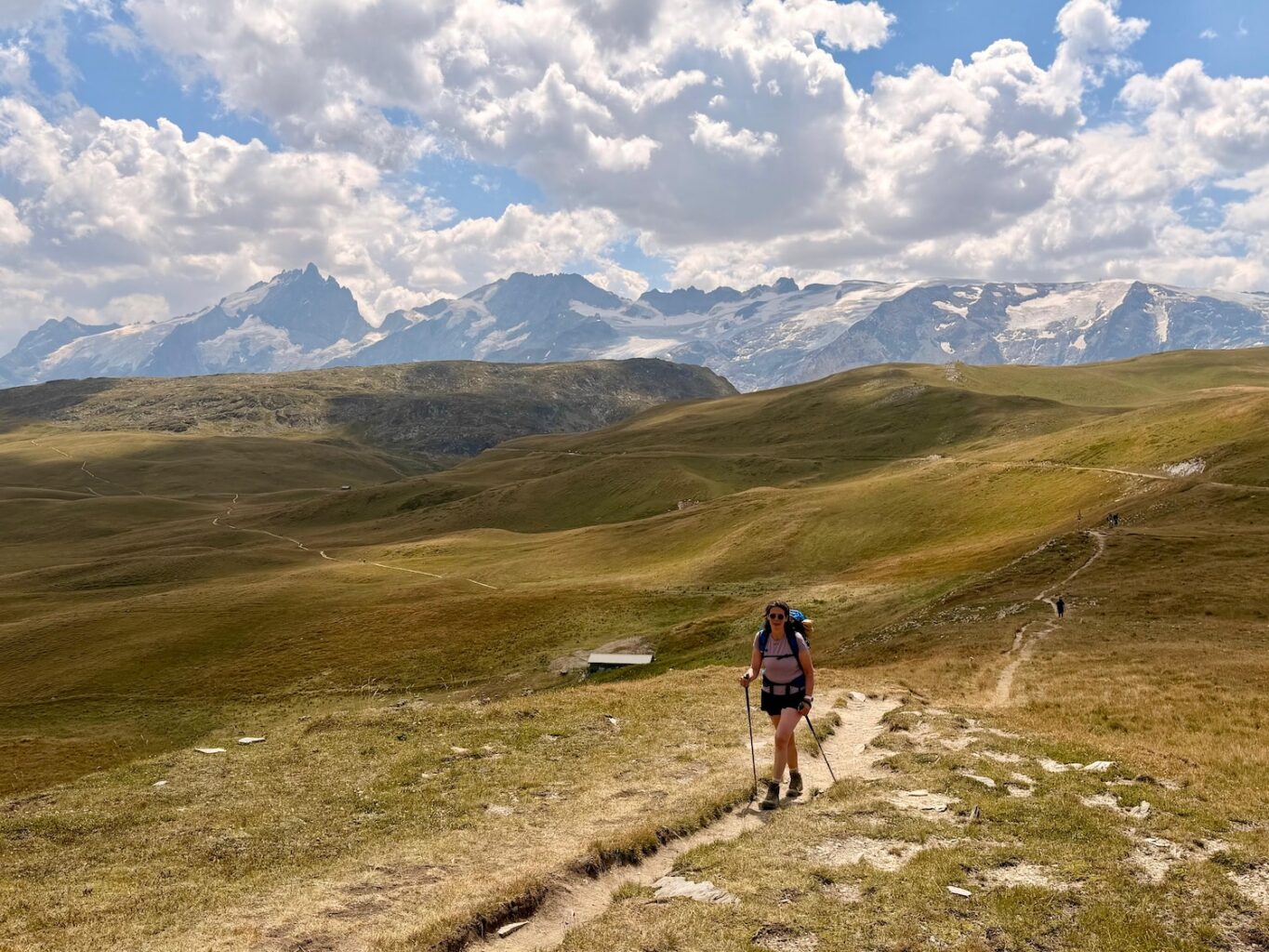
With seventeen kilometres in our legs, 1,450 metres of ascent in our knees and only one blister (namely on Lotte’s hand, from holding the pole :-)) we may contentedly conclude that our hut-to-hut walk through Les Écrins has been successfully kicked off.
PS Would you like to receive our newsletter? Just let us know, and every now and then we’ll send you an overview of a few posts.
PS II You can also find us on Instagram, in case you can’t get enough of us.
More from this tour: Our overview of the hut-to-hut walk in Les Écrins
This post was translated from Dutch with the help of AI. Read the original Dutch version.


No comments