

 22 km
 422 m
 1,012 m
 stage 12 of 12
 You walk on the Chemin de Saint-Guilhem from La Vacquerie to Saint-Guilhem-le-Désert.
The little village of La Vacquerie etc. etc. may not amount to much, at least one man lives there who can cook incredibly well. And at that man’s we eat. The restaurant is called, very originally, La Vacqueroise, has a 4.9 on Google and is run by a Belgian couple. She in the service, he in the kitchen. The menu is original and different from what we are used to. We sit wonderfully outside, a little further on an old camper van stands as a prop, and among the chatting French people we eat brandade (cod mixed with mashed potato, on a slice of bread, and pieces of chorizo over it) and boulette (a meatball Belgian style with amazing gravy). It is so good you eat your fingers off with it. Our two befriended couples also come and look around half past seven, but are sent rücksichtslos towards the bistro by the Belgian lady; she has no more room. Sorry guys!
This culinary pleasure continues cheerfully this morning. Yesterday at the épicerie we namely bought eggs, fresh brown bread and cheese. Just look at what a feast-breakfast we had this morning. With avocado with it!
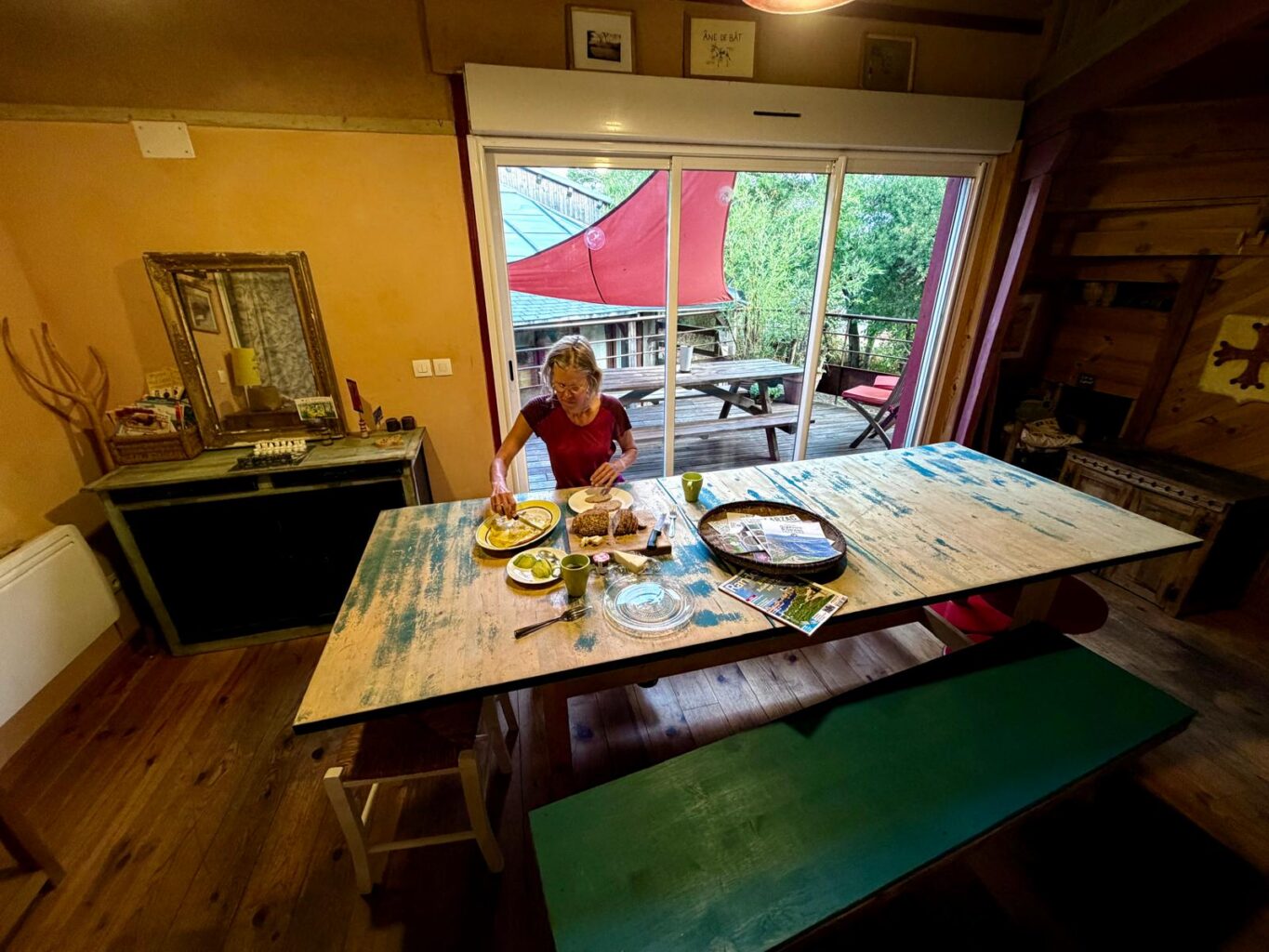
We are not getting it for free
With a sandwich with omelette in our backpack and the same in our stomach we leave this morning around 8.30. Yesterday evening and last night it rained, lightened and thundered incredibly, so the air is clean and fresh. Little shrubs that brush along our legs leave little water drops on our shins and it smells wonderful outside. Really such a smell of a summer shower on dry earth. A bit resinous, spicy, wet ground.
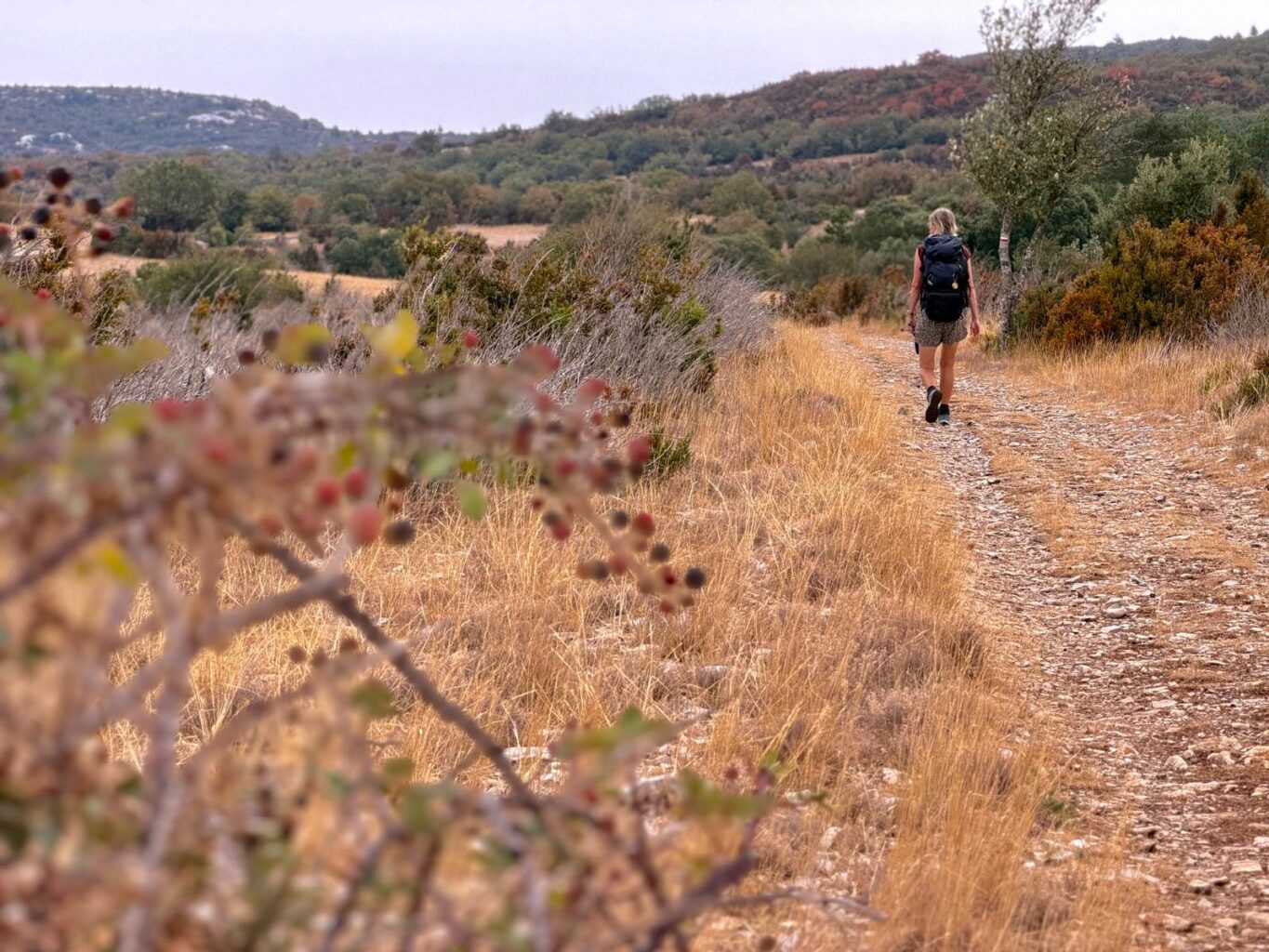
We climb out of the village and after a while look back. Beyond the Causse de Larzac, which we walked through yesterday, we see the gorge of the Cirque de Navacelles in the distance. A bizarre idea that we climbed out of it yesterday morning and that we can now see it from so far away. Even though walking goes slowly, it secretly goes quite quickly!
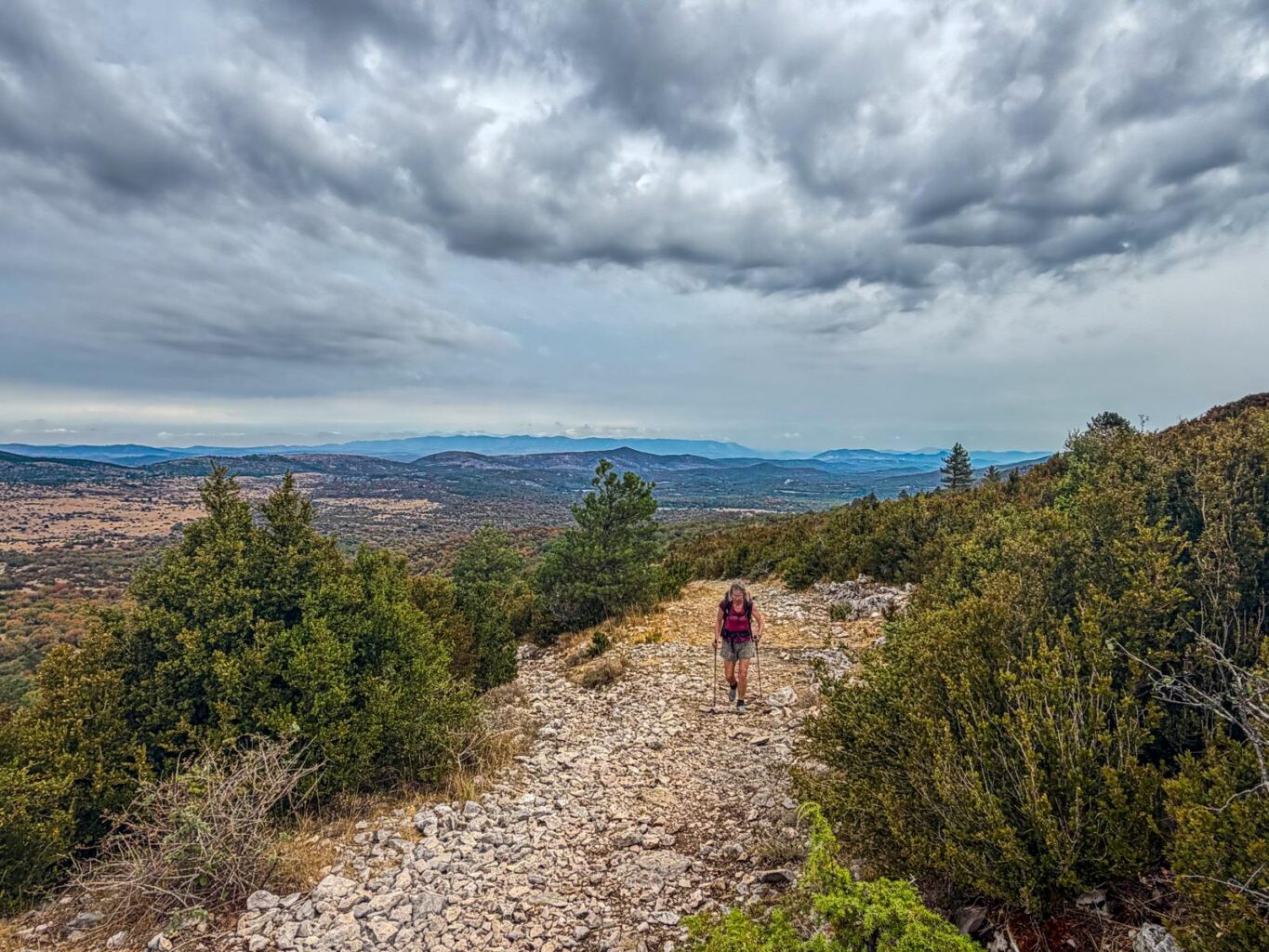
Our route today will be a tough one. Or as Pieter says at breakfast: ‘We are not getting it for free, this last day.’ It will be a good 400 metres of climbing and then a good thousand metres down. Nice for the little knees! On top of that we come through no village at all, will meet no water point and it will be warm again, about 31 degrees. Oh yes, and it is going to rain from about 13.00 to 18.00. Ah well, you apparently have to put something into it, for our St. Guilhem.
Mont Saint-Baudille
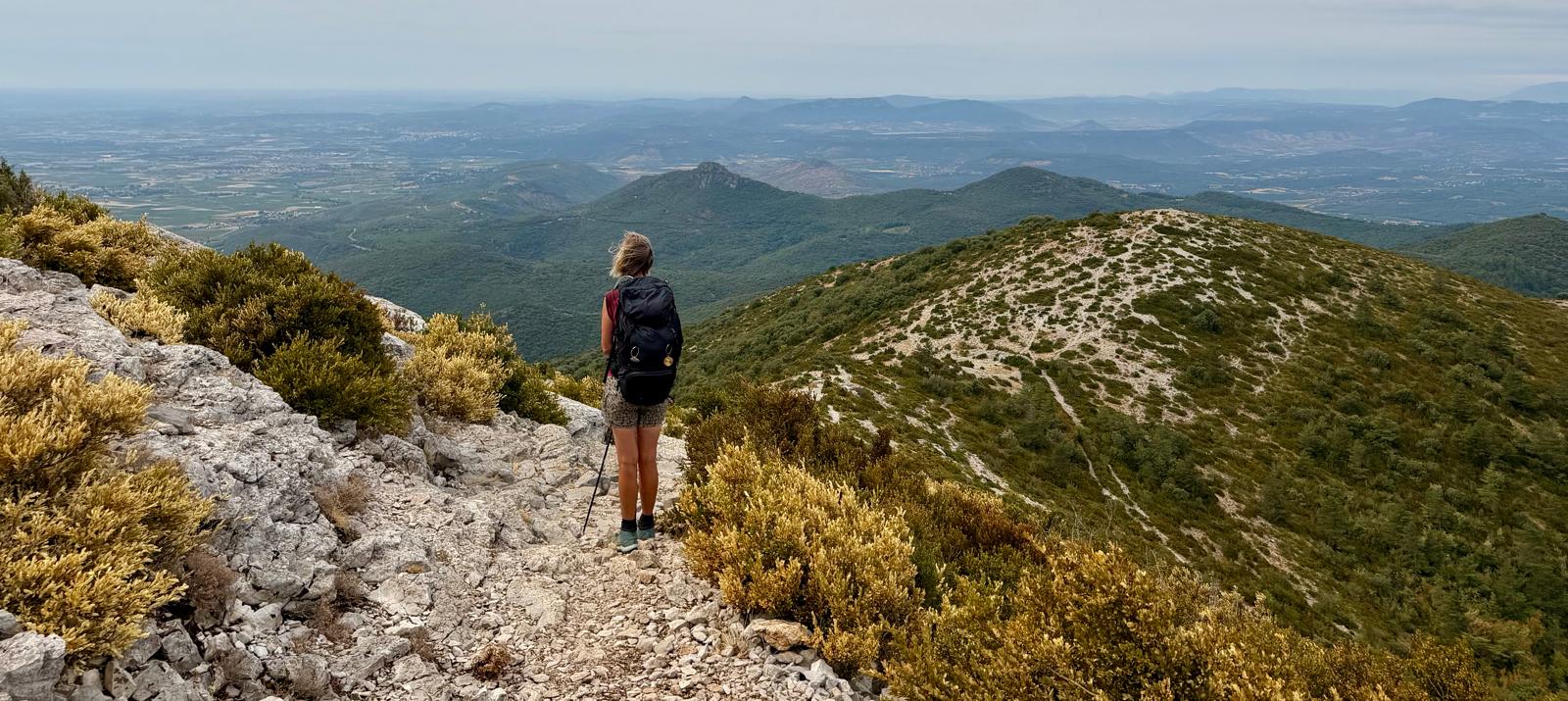
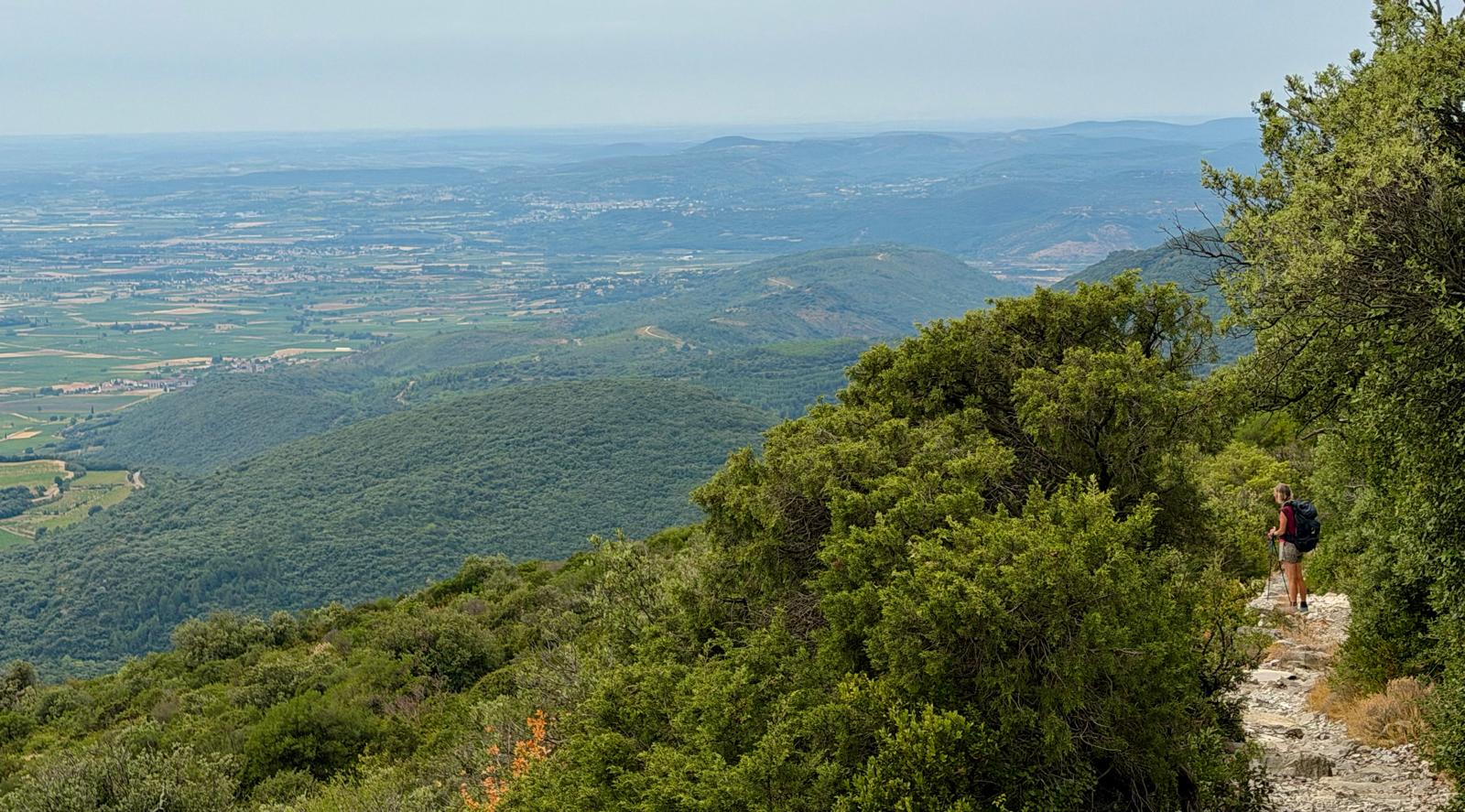
Already early in the morning our eye falls on a mountain in the distance with a gigantic antenna on it. As we walk we come ever closer to this 70-metre-high telecommunications tower. While the sun is by now being filtered by a thick layer of veil cloud, Pieter and I climb over coarse stones up Mont Saint-Baudille, as this mountain is called. Right at the top we do not know what we are seeing: a 360-degree panorama. Before us in a southerly direction lies the Mediterranean lowland and the plain of Hérault with vineyards and farmland. Behind us lies the Causse du Larzac and you see the mountain chains of the Cévennes. To the right, to the west, we see the hills of the Haute-Languedoc. When it is very clear, you see the snow-capped peaks of the Pyrenees, but today it is too hazy. And to the left lies Montpellier and you see the iconic ridges of the Pic Saint-Loup. The Mont Ventoux should also be visible, but for that too it is not clear enough. It is not bad; this is already spectacular enough!
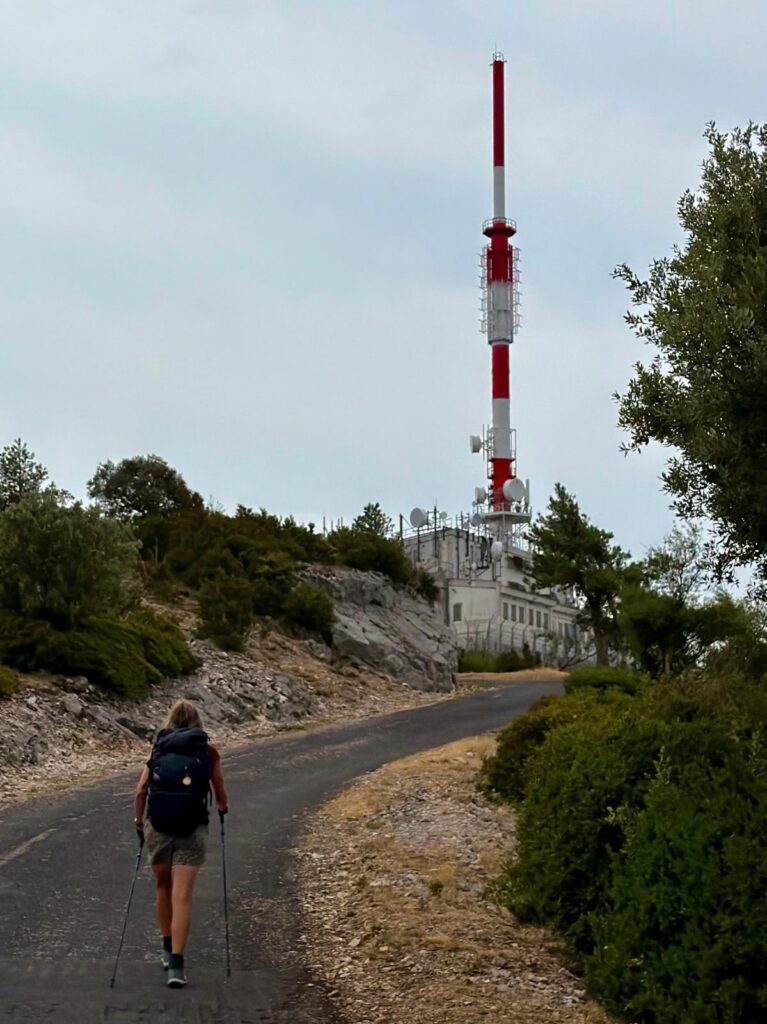
The communications tower that we already saw from afar
Descent
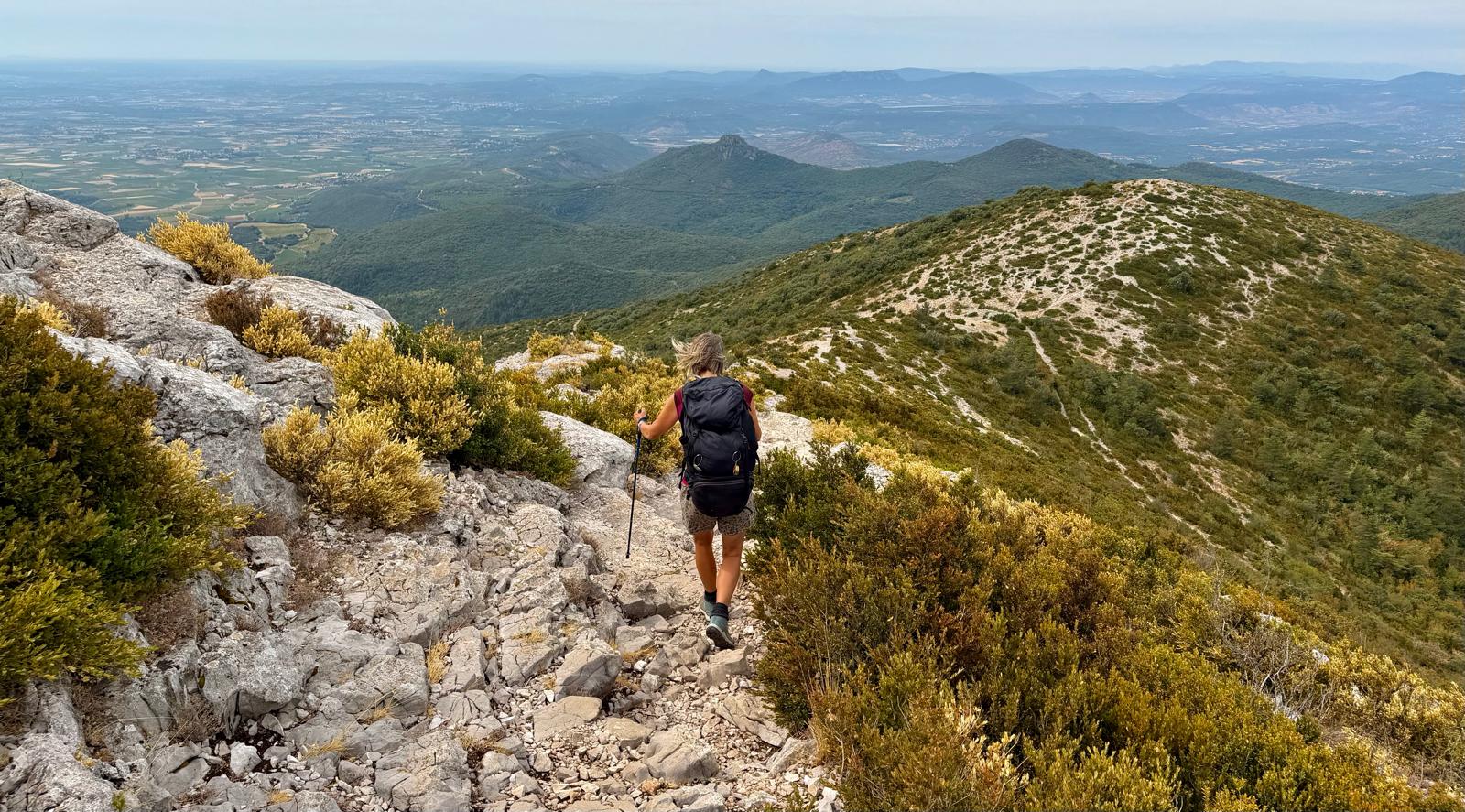
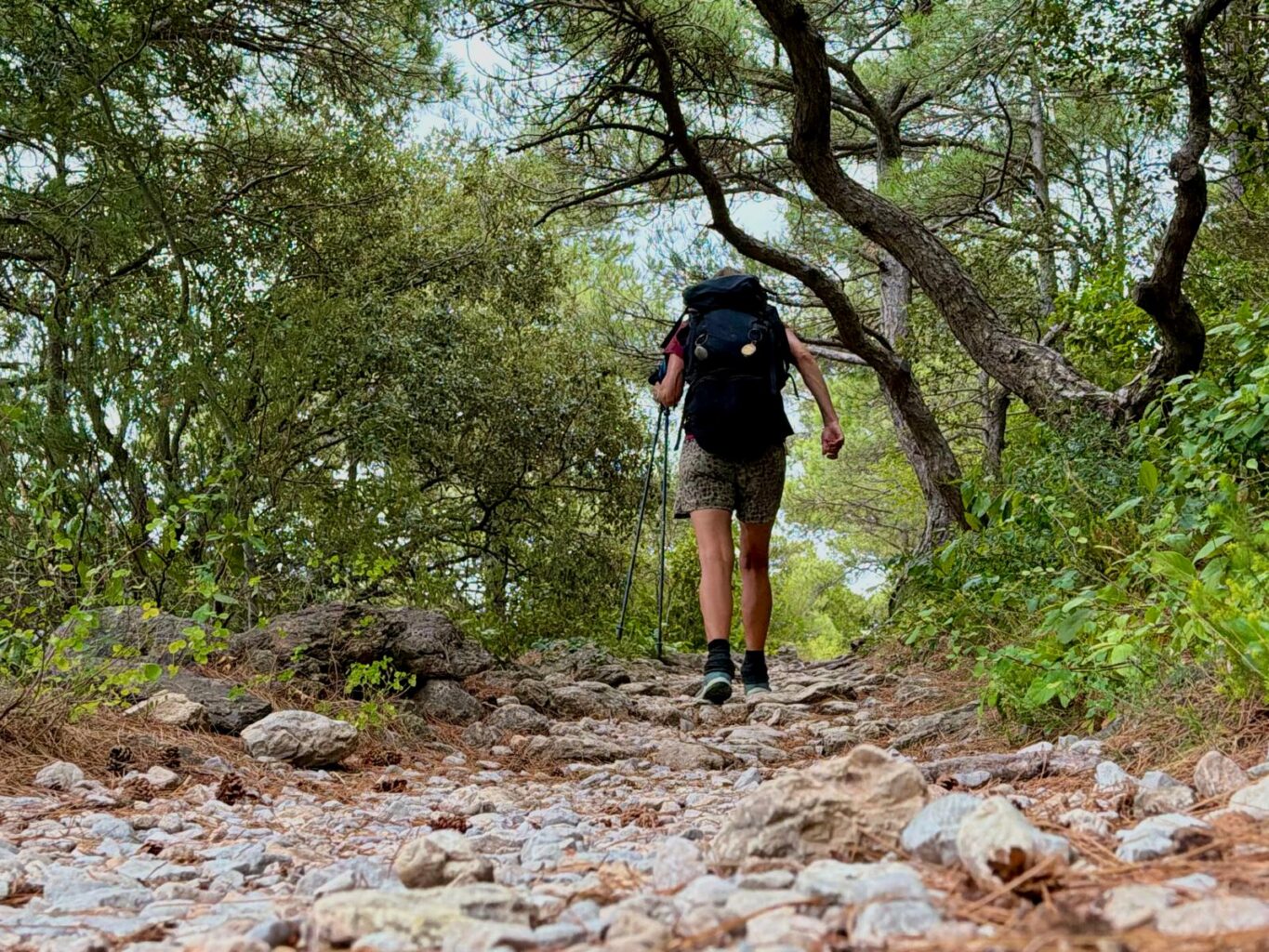
From this Mont Saint-Baudille the descent begins. The beginning is tough. It blows hard and you descend in steps over stone plateaus. The wind tugs at our shirt, we actually want to look up continuously to enjoy the view, but the path asks all our attention. After about twenty minutes the gradient changes and we can wonderfully pick up the pace. With large strides we shoot over the stony path. A young lad with a hat and sporty clothing comes walking towards us. His poles tick on the loose little stones. Not much later he comes running past us at high speed. Every step seems perfectly conceived and executed, it is beautiful to watch. Shortly after, when we are chatting with Jacques and Geneviève because we have overtaken them with our murderous pace, the boy comes walking up again. He is going for a second round!
Cirque de l’Infernet
We have meanwhile landed on a broad stone road and walk the last six kilometres relaxed. We follow a mountain flank to the left, then turn to the right, climb a little way and then our mouths fall open again in amazement. We have landed in another Cirque! This one is called Cirque de l’Infernet, which means little hell, and owes its name to the scorching heat that in summer can hang between the walls.
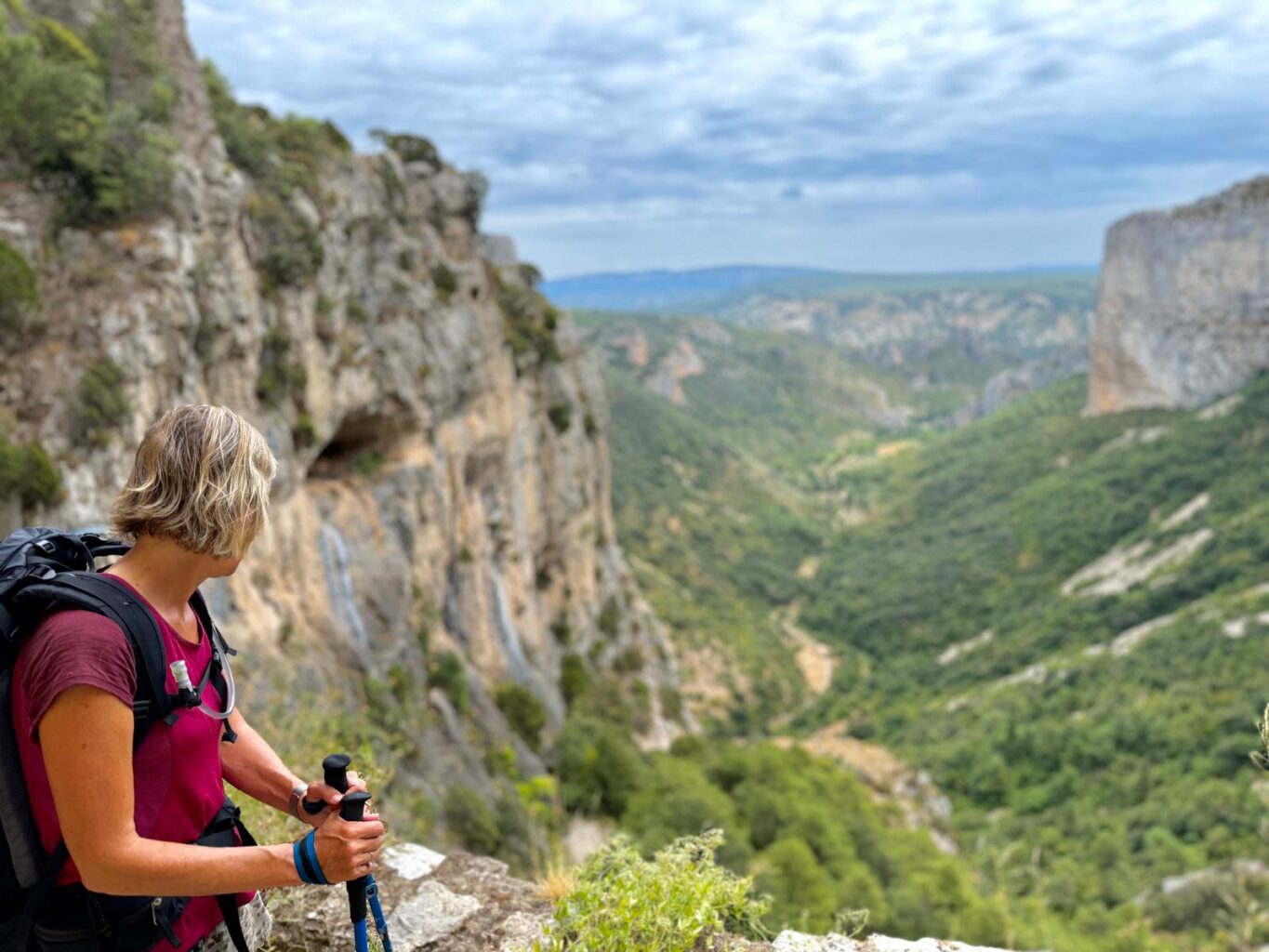
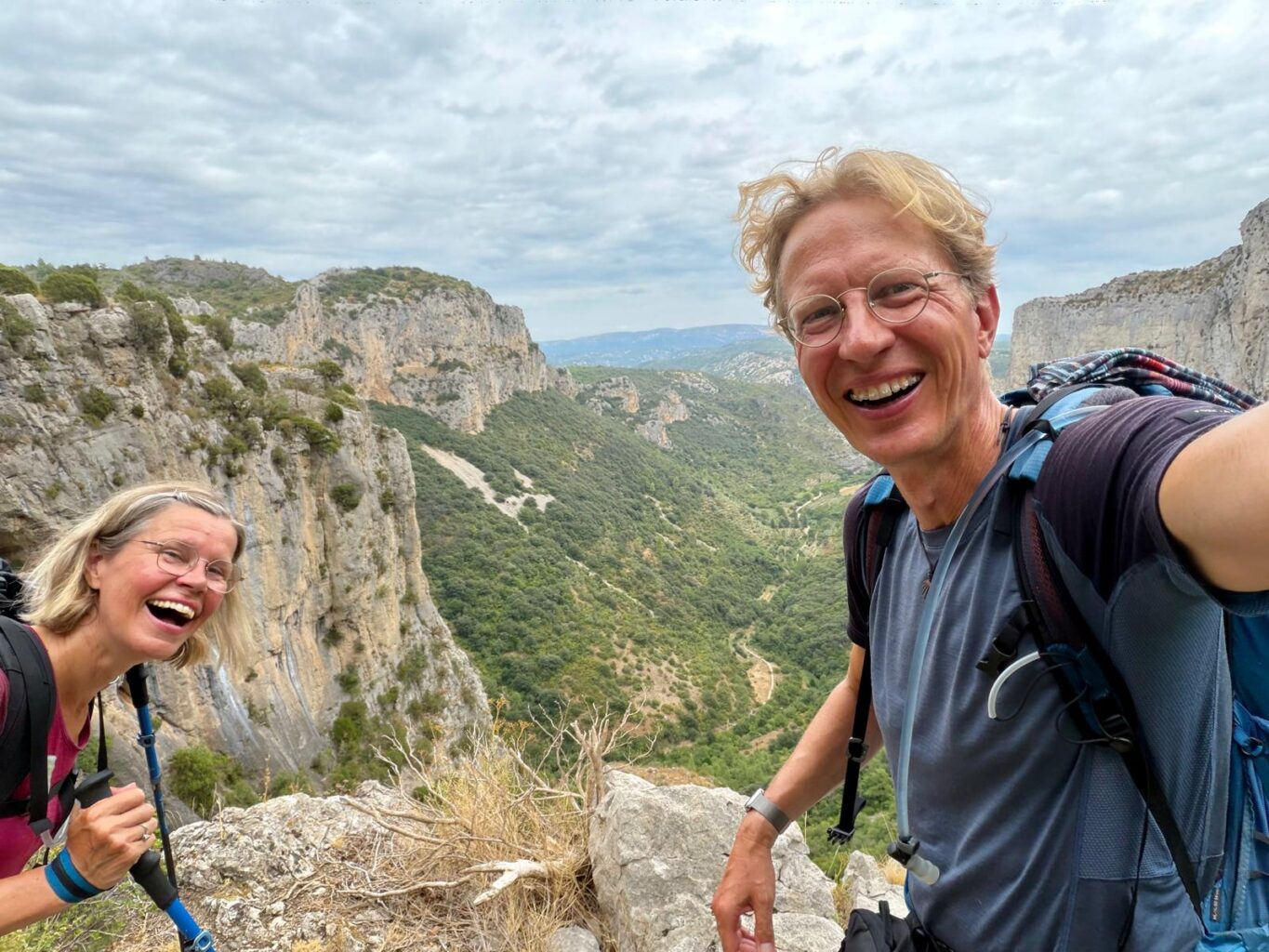
Like Navacelles this is a cirque of steep limestone walls. From the bed of the little river the Verdus down in the valley those walls rise fully 400 metres straight up. Around us the rugged, bare cliffs tower towards the sky. Below us we see pine forests, an old olive plantation and little holm oaks. In front of us, a little lower, we see Richard, Isabel, Jacques and Geneviève shuffling tightly along the vertical walls. Oh my god that looks exciting. When I call to them, the sound echoes via the walls back into our ears. They all look up and wave. Apparently it is not so frightening that they don’t have the puff for that.
A monk’s labour
First we descend over Les Fenestrettes, an incredibly impressive mule path that centuries ago was hewn and shored out of the steep rock face by the monks of the Abbey of Gellone (the abbey that was founded by St. Guilhem). Over a broad wall we walk winding down via tight hairpin bends. Then we walk into a forest again. This time no pine trees but holm oaks along the path, which is further edged with shrubs with ringing names such as snowball, strawberry tree, Phoenician juniper and many-flowered heath.
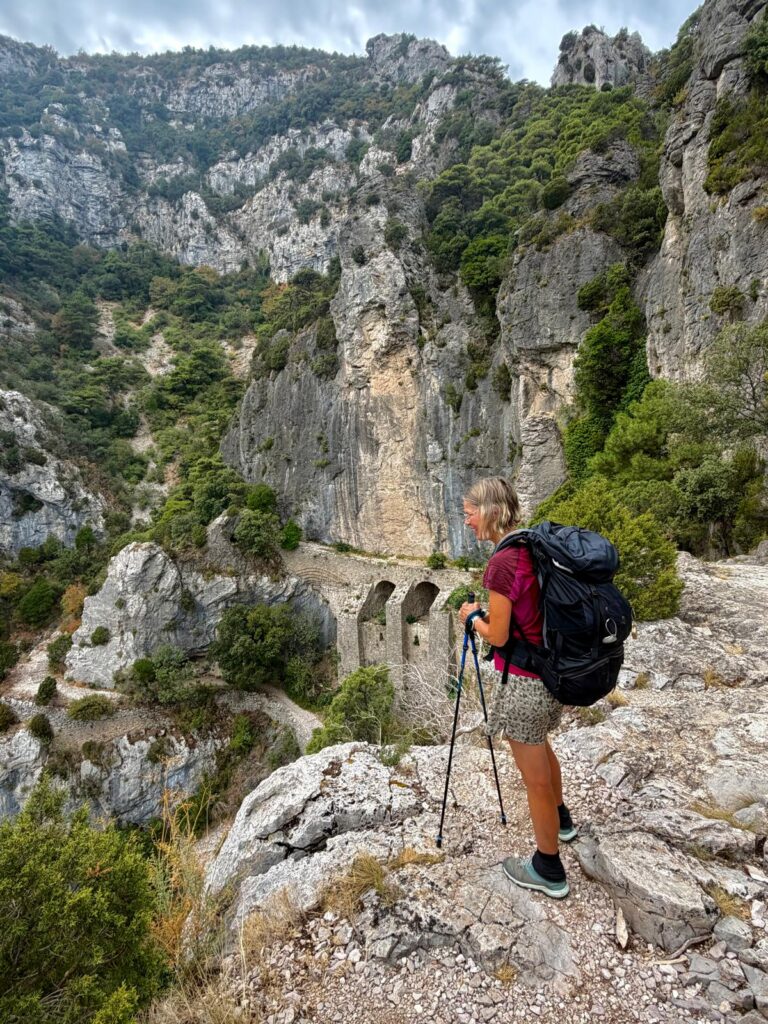
I have just been standing waving and calling to our friends. In front of my hands you see the path that the monks hewed out and that we will have to walk later. Looks quite frightening, doesn’t it?
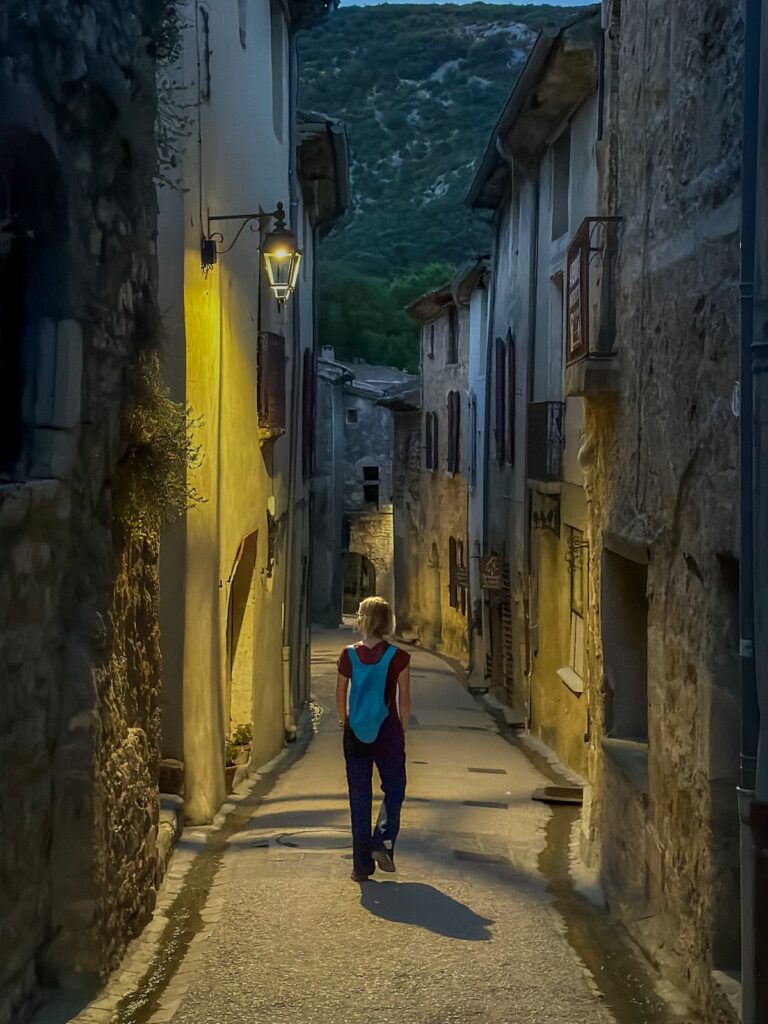
These are the last kilometres. We enjoy to the full the beautiful cirque in which we walk, and where the sudden appearance of the little village of Saint-Guilhem-le-Désert surprises us. Suddenly it lies there. The old monastery village counts only 250 inhabitants, but during the year is visited by fully a million tourists. They come during the day and leave again when evening comes. Until ten there are then also no shops or little bars open, and after nine in the evening a deep calm settles over the village.
Abbey of Gellone
We walk over the old cobbled streets and through narrow alleyways to our gîte, take a shower, rest our legs a moment, and then it is on to the Abbey of Gellone. That is after all the official end point of this pilgrimage route. William of Gellone (St. Guilhem, that is) founded this abbey in 804. It is considered a beautiful example of early Romanesque building style. Inside it is sober. No embellishment, no art, not even stained glass. Only the sunlight that falls in through narrow windows. At the front of the church a few people sit completely clad in white on their knees praying. It is mouse-still and cold there. We get goosebumps from it, it is so beautiful.
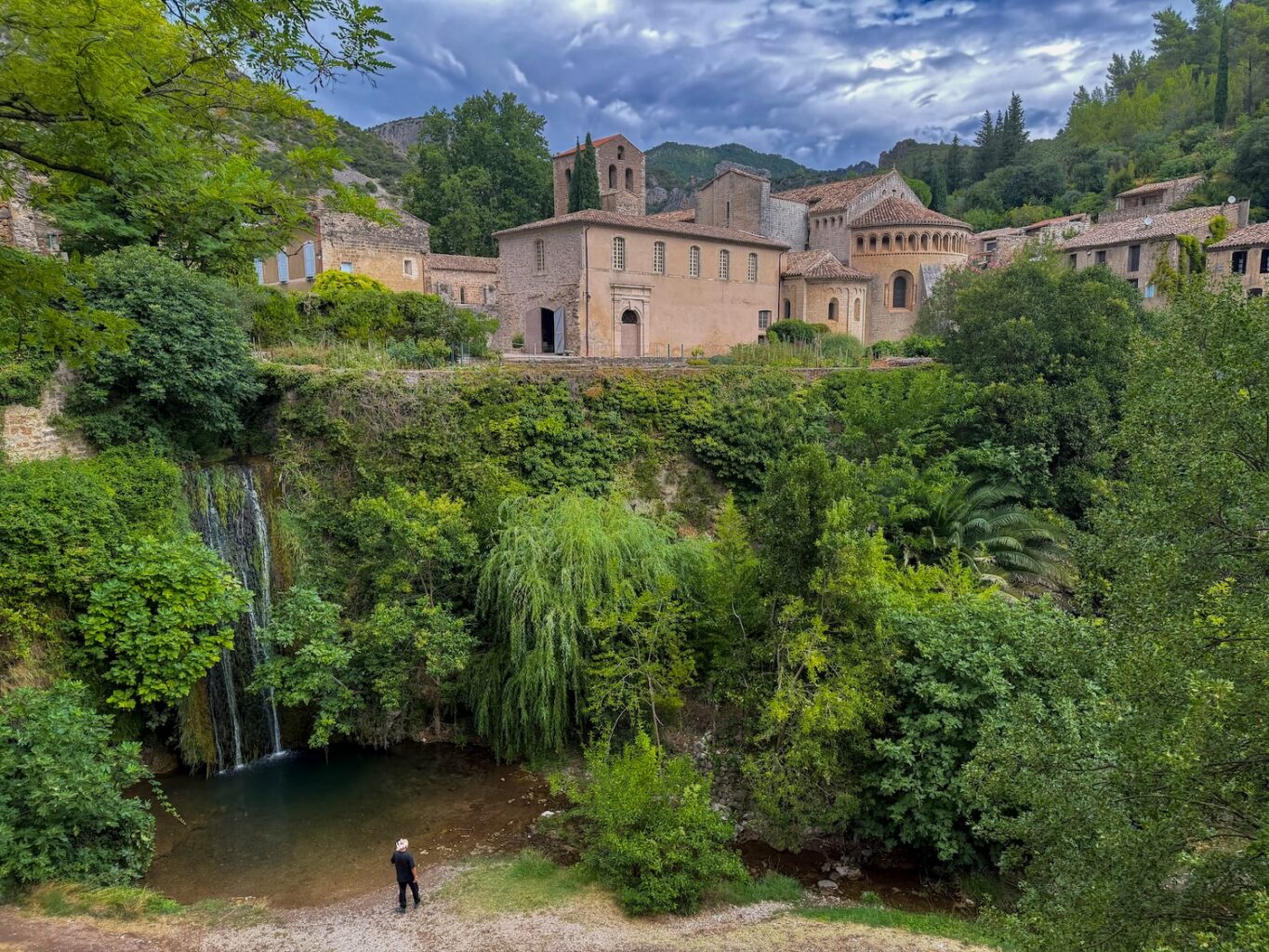
The Abbey of Gellone, with down by the waterfall a man who looks exactly like the professor from Back to the Future
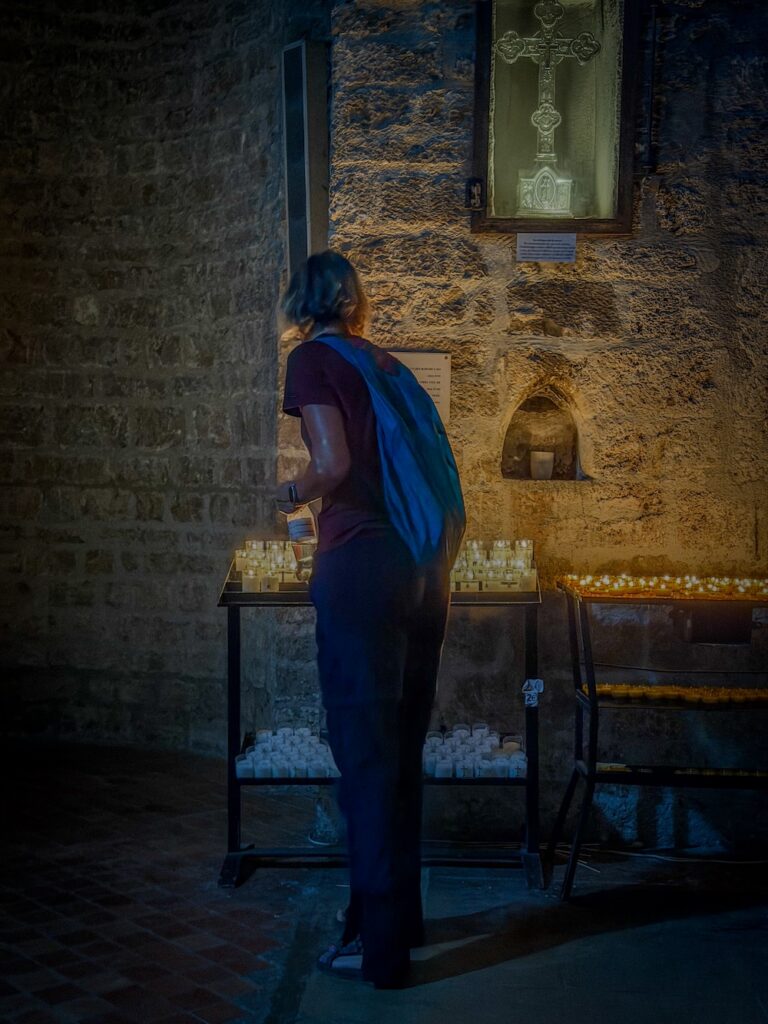
We light a little candle. Even if perhaps we were not given the day for free, everything about the day felt like one great gift. A gift that we accept with gratitude.
Elevation: 422 m up, 1,012 m down
Sleep: Gîte de la Tour
Cost: 85 euros for a double room with a shared bathroom
PS Would you like to receive our newsletter? Just let us know, and every now and then we’ll send you an overview of a few posts.
PS II You can also find us on Instagram, in case you can’t get enough of us.
More from this tour: Our Chemin St. Guilhem overview
This post was translated from Dutch with the help of AI. Read the original Dutch version.


No comments